Marty McGuire

Posts Tagged machine-knitting

2025
Sat Dec 13

Machine knittin': moar mittens

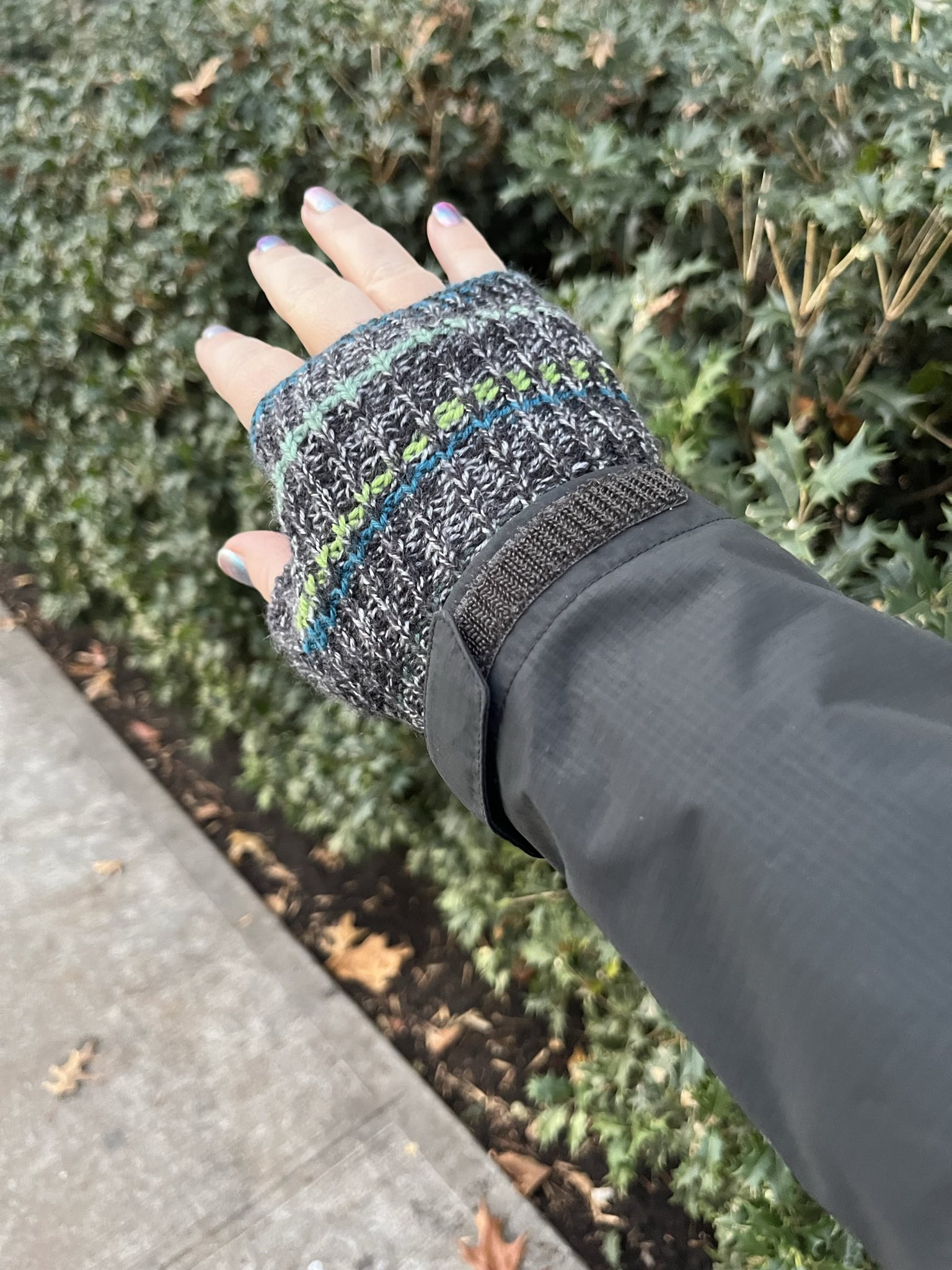
I am pleased to report that producer Amy approved of the mittens I posted a couple of weeks ago, which were a bit too small for me.

"Sooo cozy!" was the text accompanying this photo of Amy's hand with pearlescent nail polish and a woollen knit mitt.

"How nice," I thought, "to have made something functional and enjoyable. Now to make a new pair for me. I'll use this different sock yarn, that Amy bought me in Berlin, so we can easily tell them apart. This should be nice and straightforward!"

Ha ha ha! Ha-ha! Ha.

Readers to enjoy a tl;dr: this worked out fine, but not before multiple failures and some wrestling with broken self-confidence.

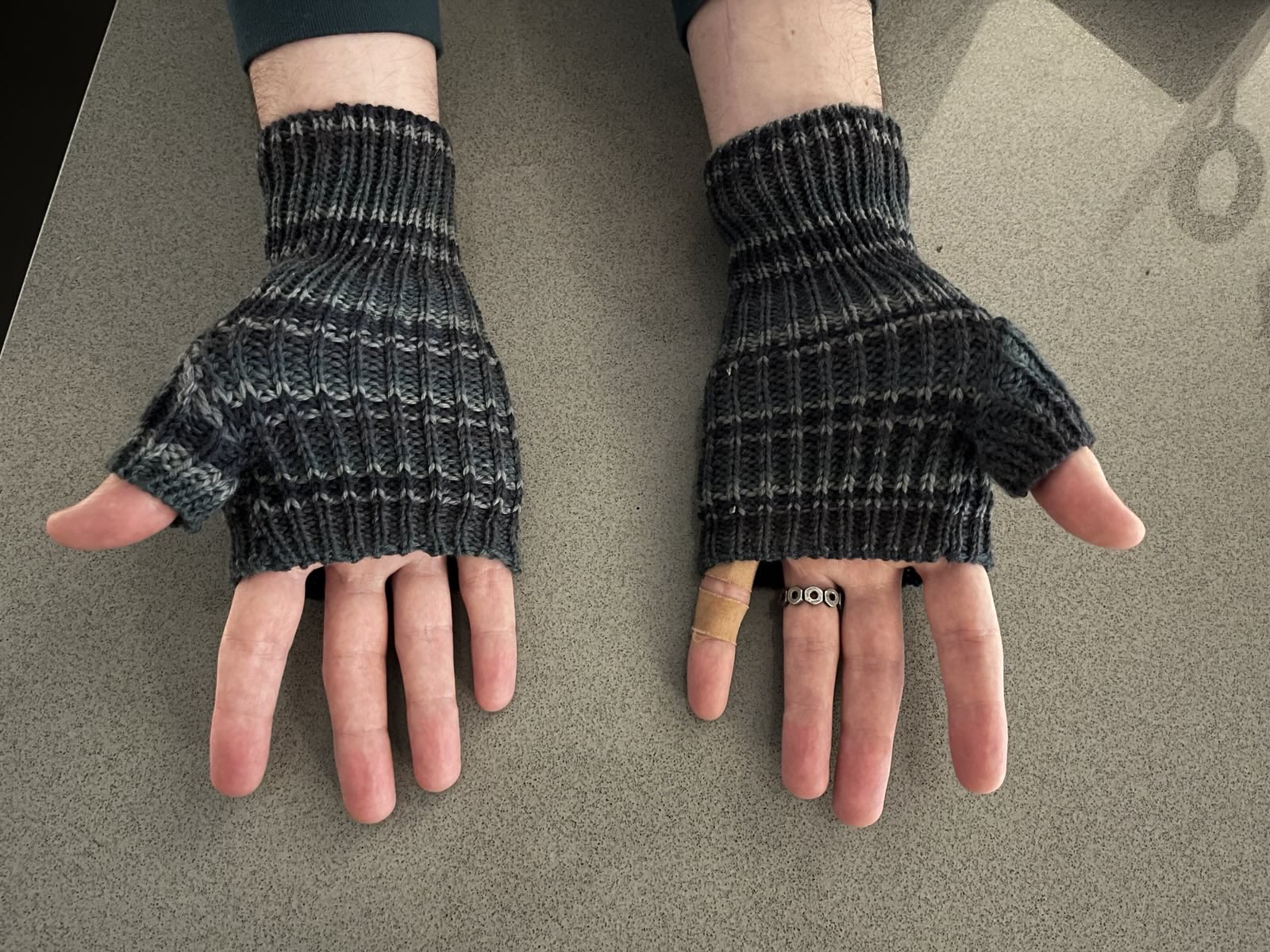
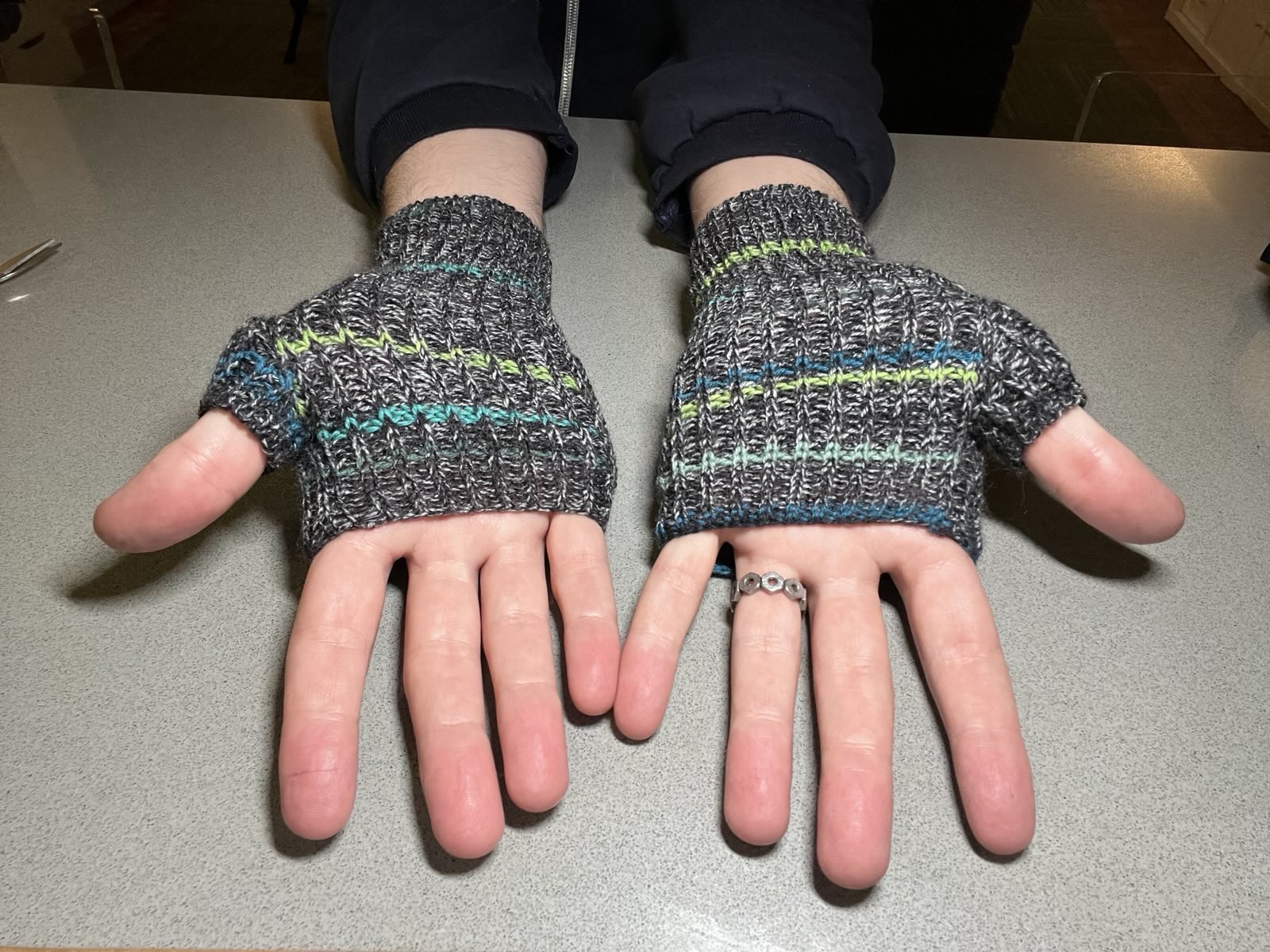
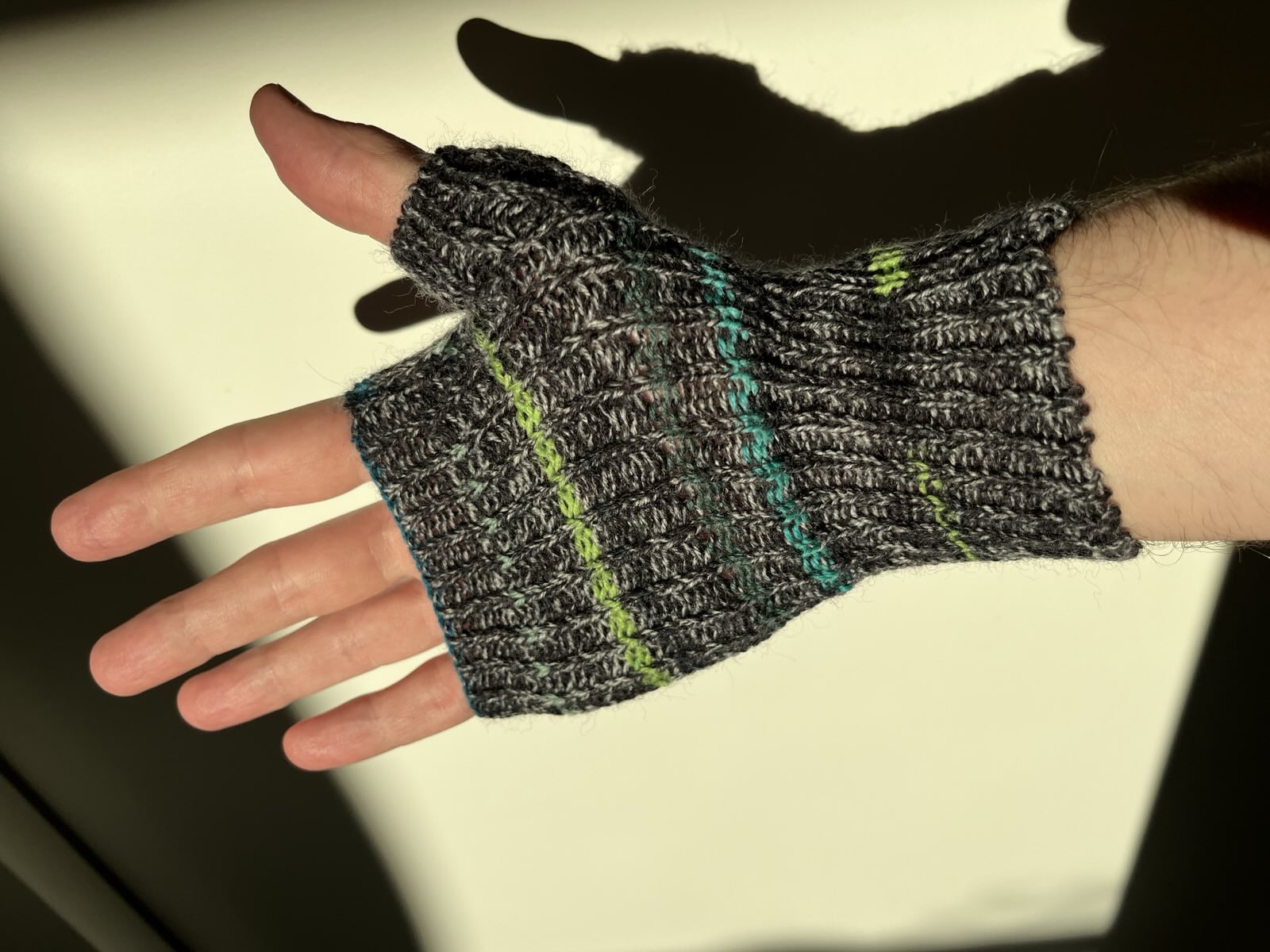
Palms up, blue and gray variegated mitts on my hands. My left pinky has a tell-tale Band-aid visible.
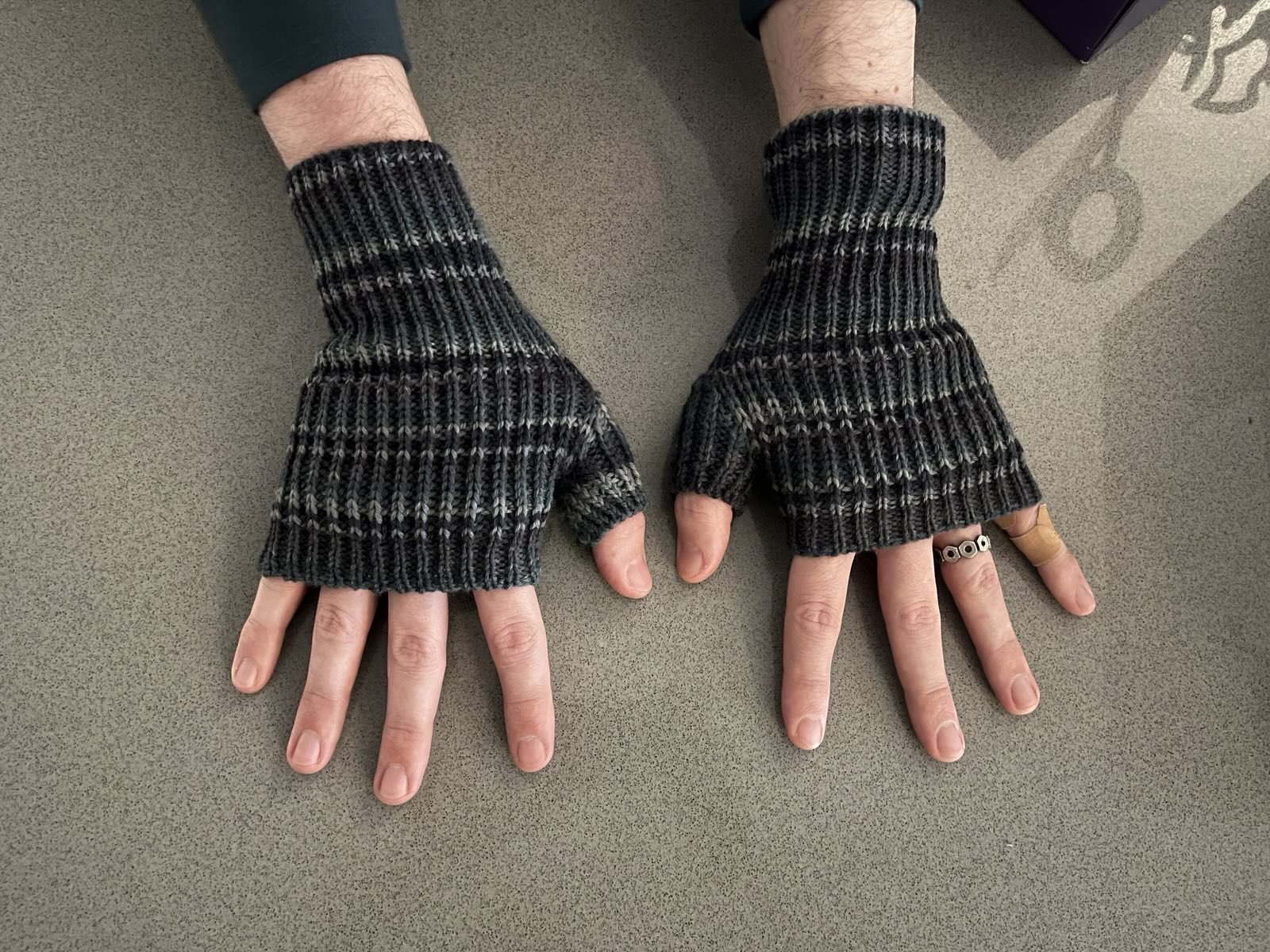
Palms down view.

This is still a variant of the Fingerless Mitt to Knit by Diana Sullivan (from Austin, TX). Here were the changes that finally worked for me, with this yarn:

  • Body of the mitt is 55 stitches wide. Thumb is 4 stitches wider, using needles from 14L to 15R.
  • Knitting tension is T7 on both carriages. Near (but not at!) the loosest possible tension for my ribber carriage.
  • Manually loosen the yarn in the tension mast before knitting each row. The carriages screeched and often jammed, but I was able to jiggle them across with great anxiety about breaking my machine.
  • For the top of the mitts, I learned how to do a proper 1x1 rib bind-off. I liked Diana's "Simpler Smiles & Frowns Bind-Off" video for this.

I really like how they turned out! I'm excited to put them to the test in the cold season!

Now, for the strong-willed reader, let's talk about some challenges!

Like most machine knitting projects, my issues can mostly be traced back to skipping the swatching step(s). This design relies on the stretchiness of two types of rib. The mitts "at rest" appear quite small, then stretch to snugly cover the hands. I'm not confident I would have been able to consistently measure gauge in a way that allowed comparing the stretched size of different yarns and tensions. But I should have tried!! I might have decided early on what I believe now, which is that this particular sock yarn is too thick to work well with my standard gauge machine.

Instead, I jumped right into a first attempt with extra stitches and rows, but holding everything else the same, including the tension. This was a miserable experience, with the carriages jamming constantly. The machine was basically telling me "no no no, stop, no" the whole time. Would that I had listened! I managed (through sweat and anxiety) to finish it, but the resulting fabric was uncomfortably thick and tight. The loop-through-loop bind-off at the top of the mitt was also still too tight to spread my fingers while wearing it.

For attempt number two, I decided to up the tension to T6, but otherwise go back to the original stitch and row counts. This went a little better in terms of process and the fabric, but it was still too tight to wear.

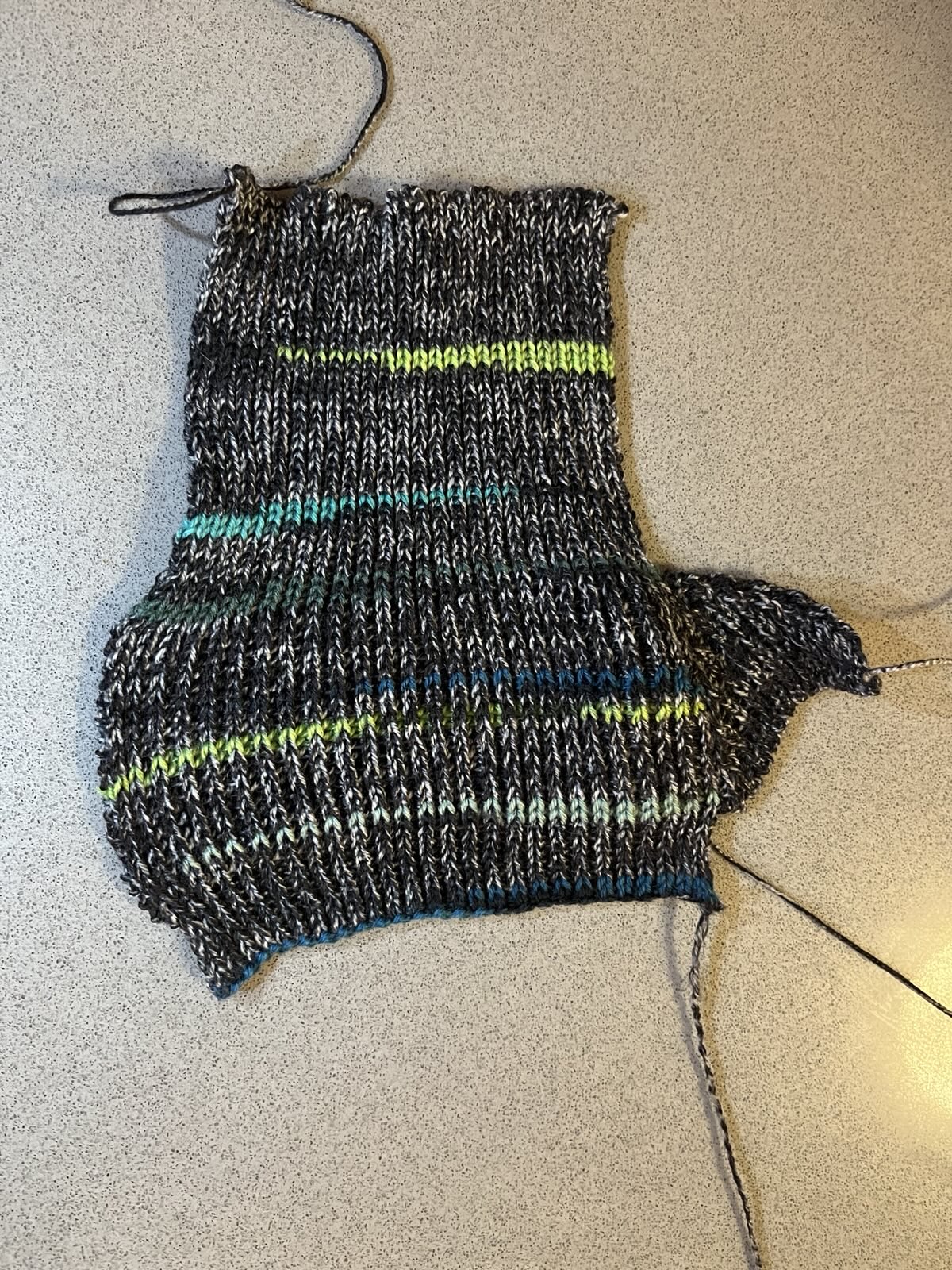
I got a lot of practice doing the hand sewing to make-up the pieces into the mitts. This was starting to feel like a lot of work for two disappointments. So I ended up taking a break for several days. I spent some of that time researching properly stretchy bind-offs and focusing on non-knitting projects, but mostly I was just feeling the sting of failure, haha.

Finally, I did some practice at looser tensions, doing a few rows at T7 and T8 to see if I could find a technique that would actually knit smoothly with this yarn. I couldn't! But I did found that T7 was the least likely to bind up. I finished the body of the mitt at T7 well enough. I decided to "do an easier version" of the bind-off, skipping the step of casting off onto waste yarn and stitching it up on the machine, freeing each stitch from the machine as I sewed it up.

It was during a break in this process with many needles out in hold position, that I carelessly waved my hand and impaled my left pinky finger on 2 or 3 needles. With some help from producer Amy, I got bandaged up and returned to work.🩸🩹

The result was... fine? It looks very inconsistent when the mitt is at rest, but it's very nice and stretchy and, when stretched out on the hand, I think it looks OK. Hooray, mobility!

For the last mitt, I combined all my hard-earned knowledge so far, and did a proper waste yarn bind-off to finish the top ribbing. The added steps felt more time-consuming, but I think the sewing up went a lot faster. It certainly looks a lot better!

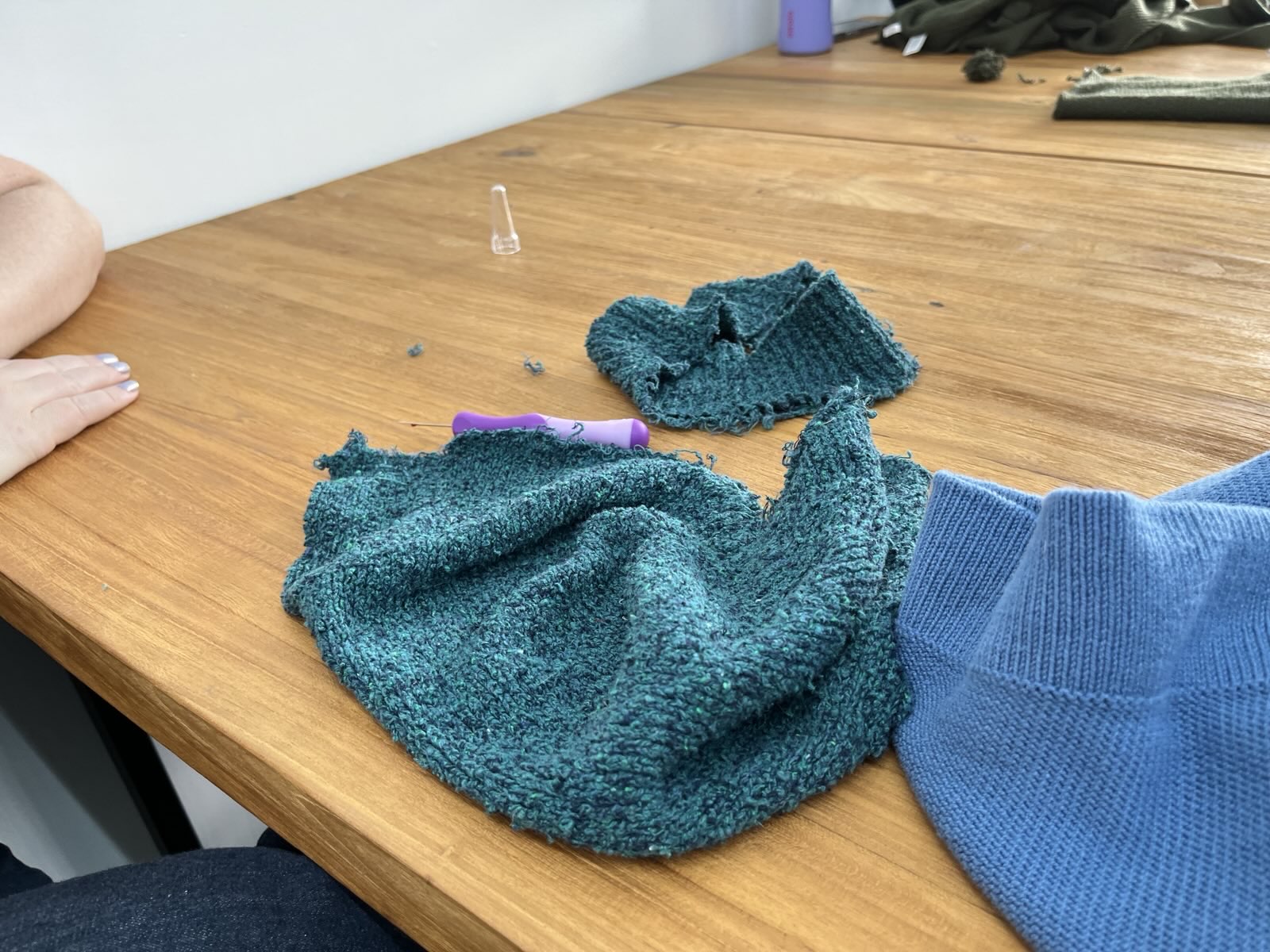
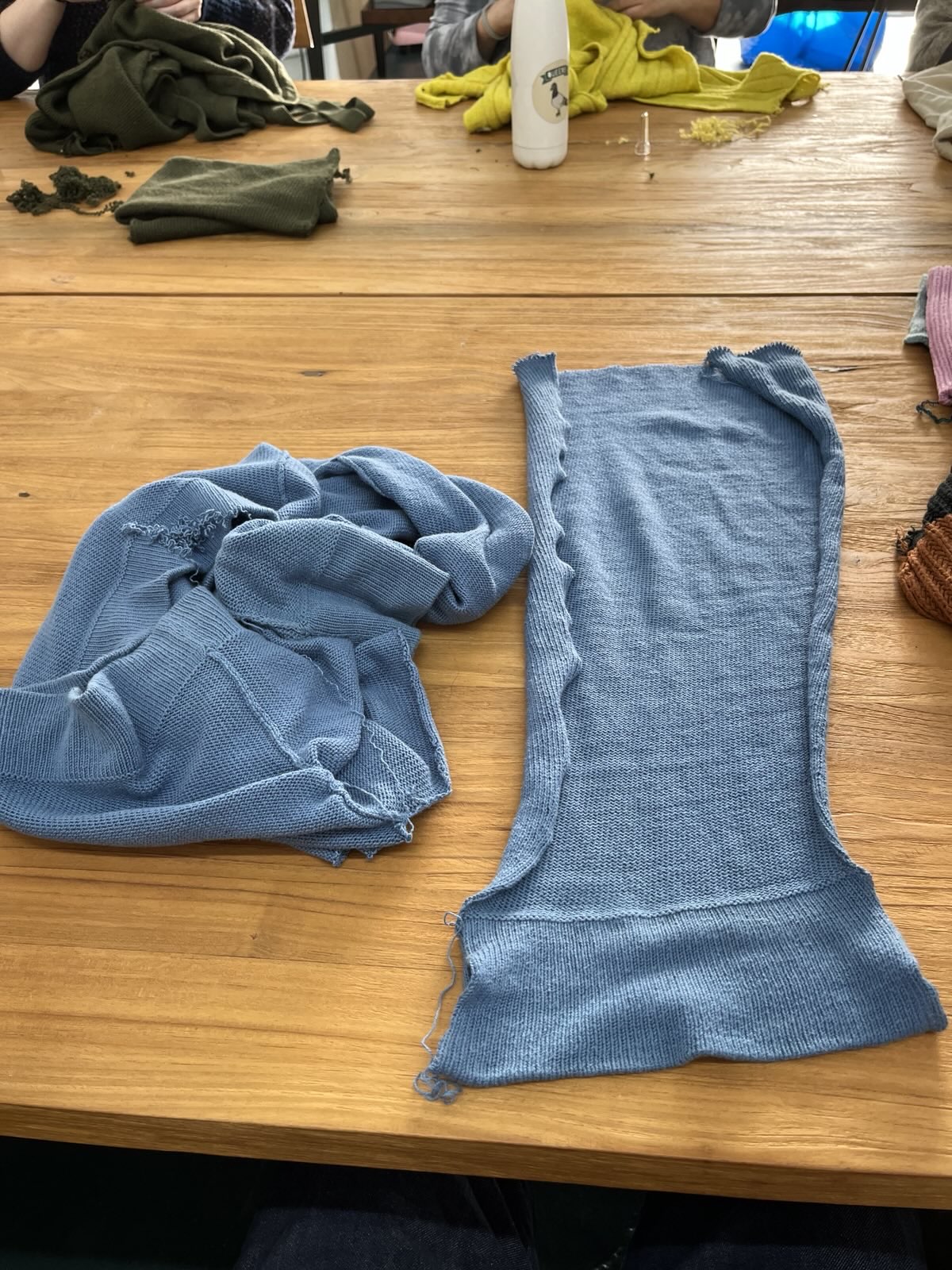
I'm not sure what I'll do with the failed mitts and the as-yet-unused portion of sock yarn. The machine definitely does not like it. Probably it should be used for someone else's hand knit or crochet project.

Thanks for reading! I have more knitting projects I'm looking forward to posting soon.

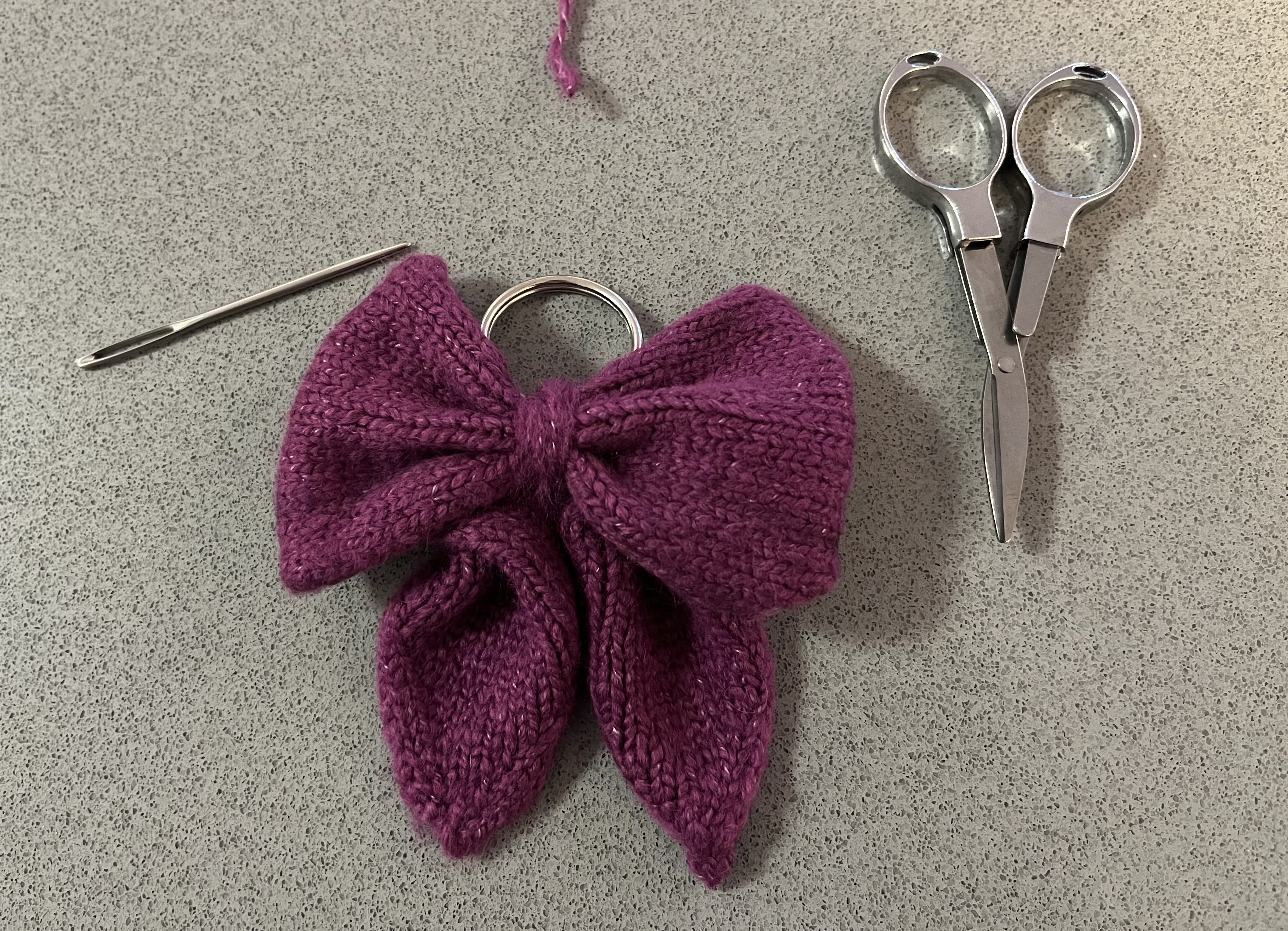
Yesterday was a good day to make a little bow.

Bow machine knit from maroon-colored yarn with a keyring attached, next to tapestry needle and sewing scissors.
Tue Dec 2

Machine Knittin': Some mittens

I took another (unsuccessful) run at the previously-failed neckline for the knitalong sweater this weekend. I have learned that I have much to learn about taking off ribbing with circular knitting but also I don't want to talk about it.

Instead let's talk about these!

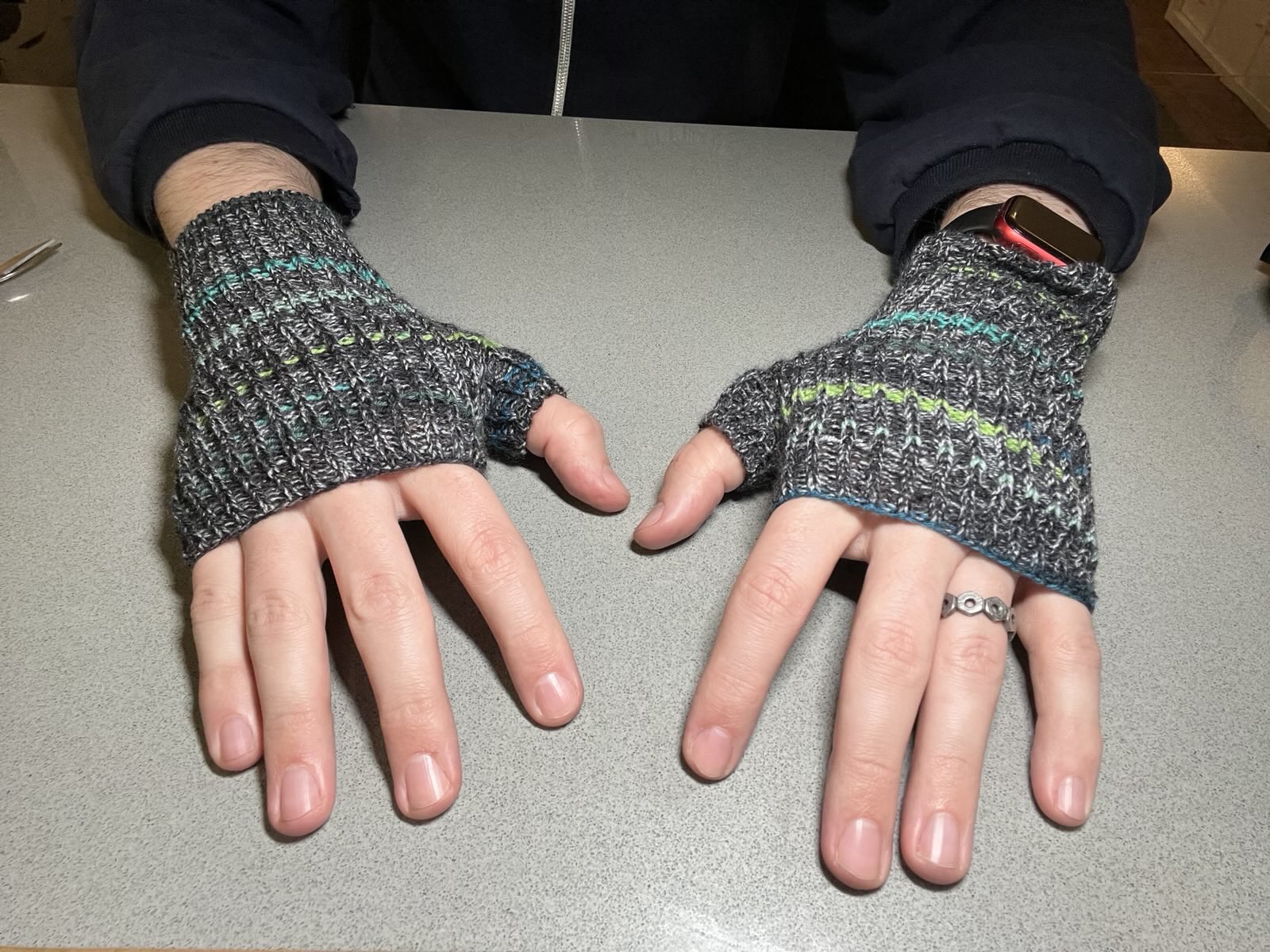
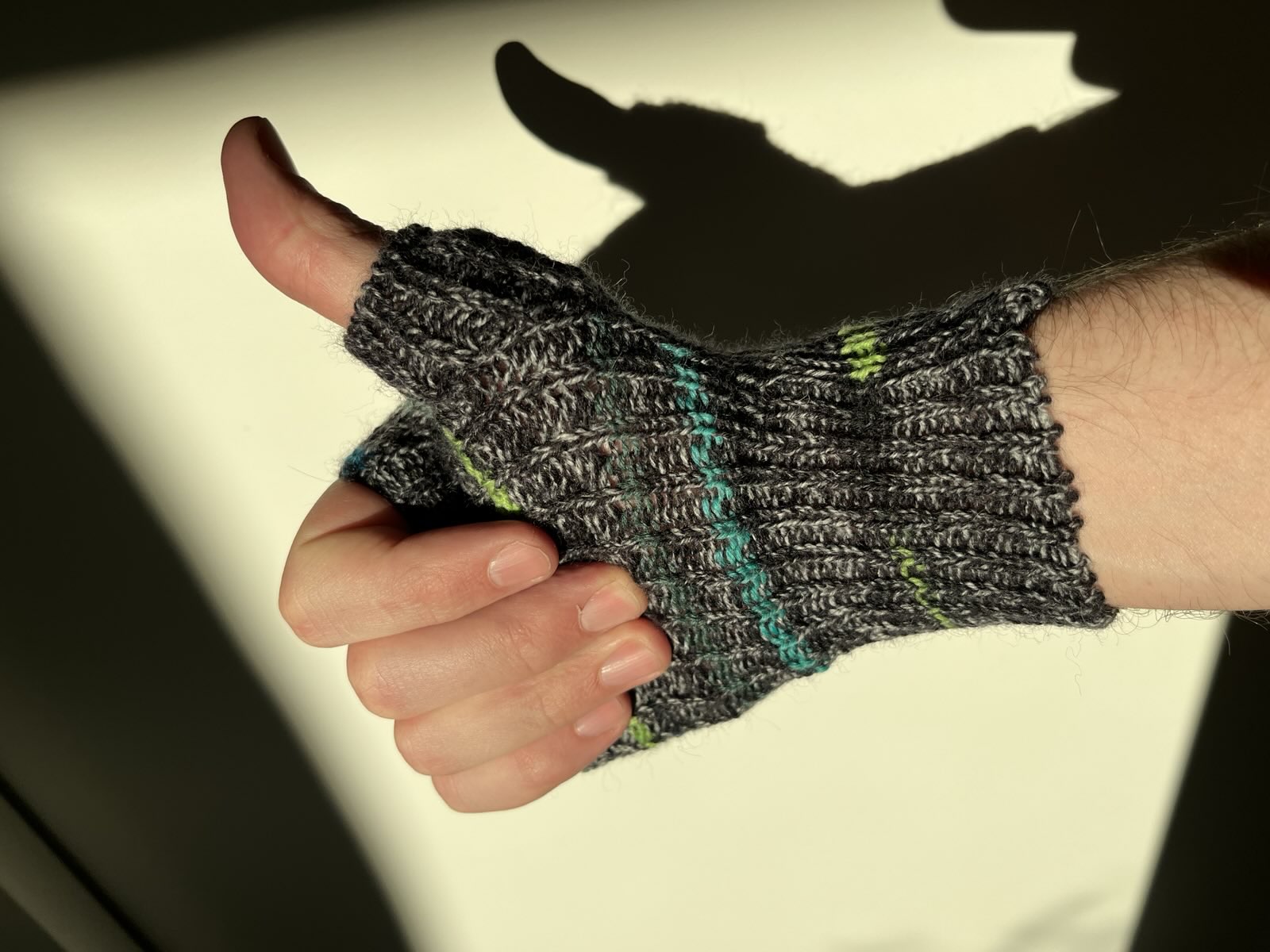
My hands modeling fingerless gray mitts with blue and green color variations with 1x1 and English rib textures.
The "palms-up" view of the same mitts.

I made these based on the Fingerless Mitt to Knit by Diana Sullivan (from Austin, TX). Diana doesn't give gauge or final measurements, or discuss blocking, so I made them almost exactly according to pattern.

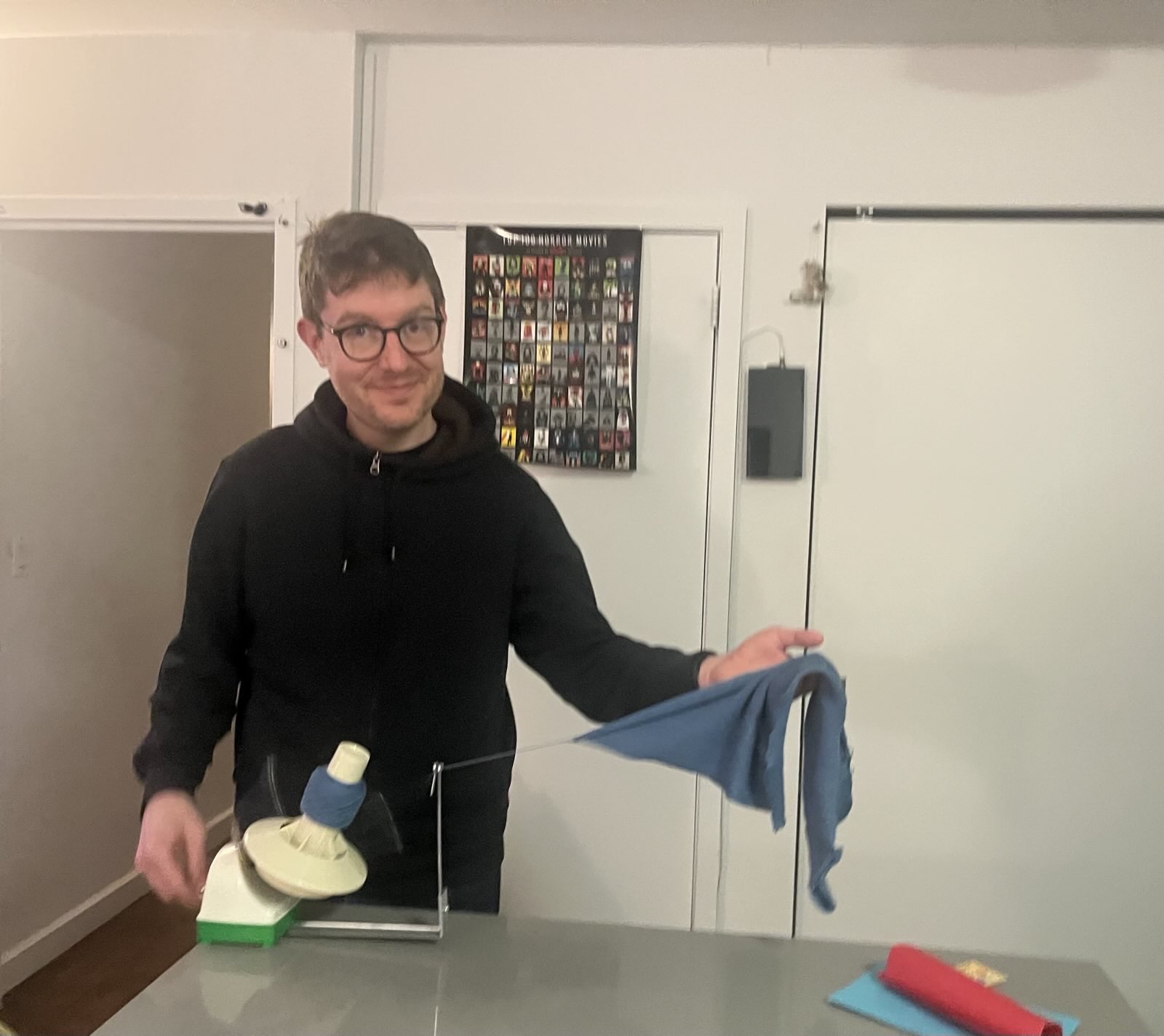
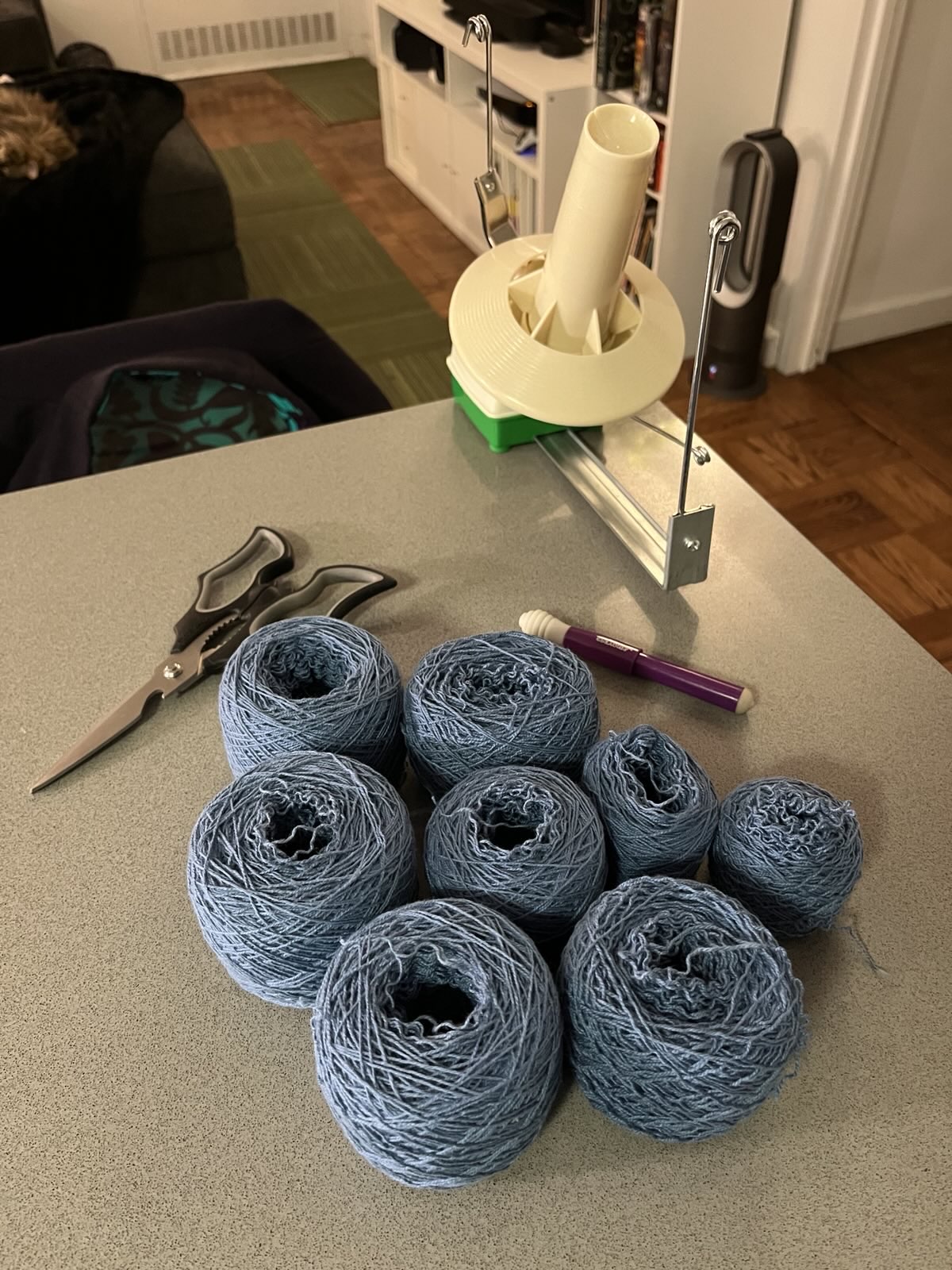
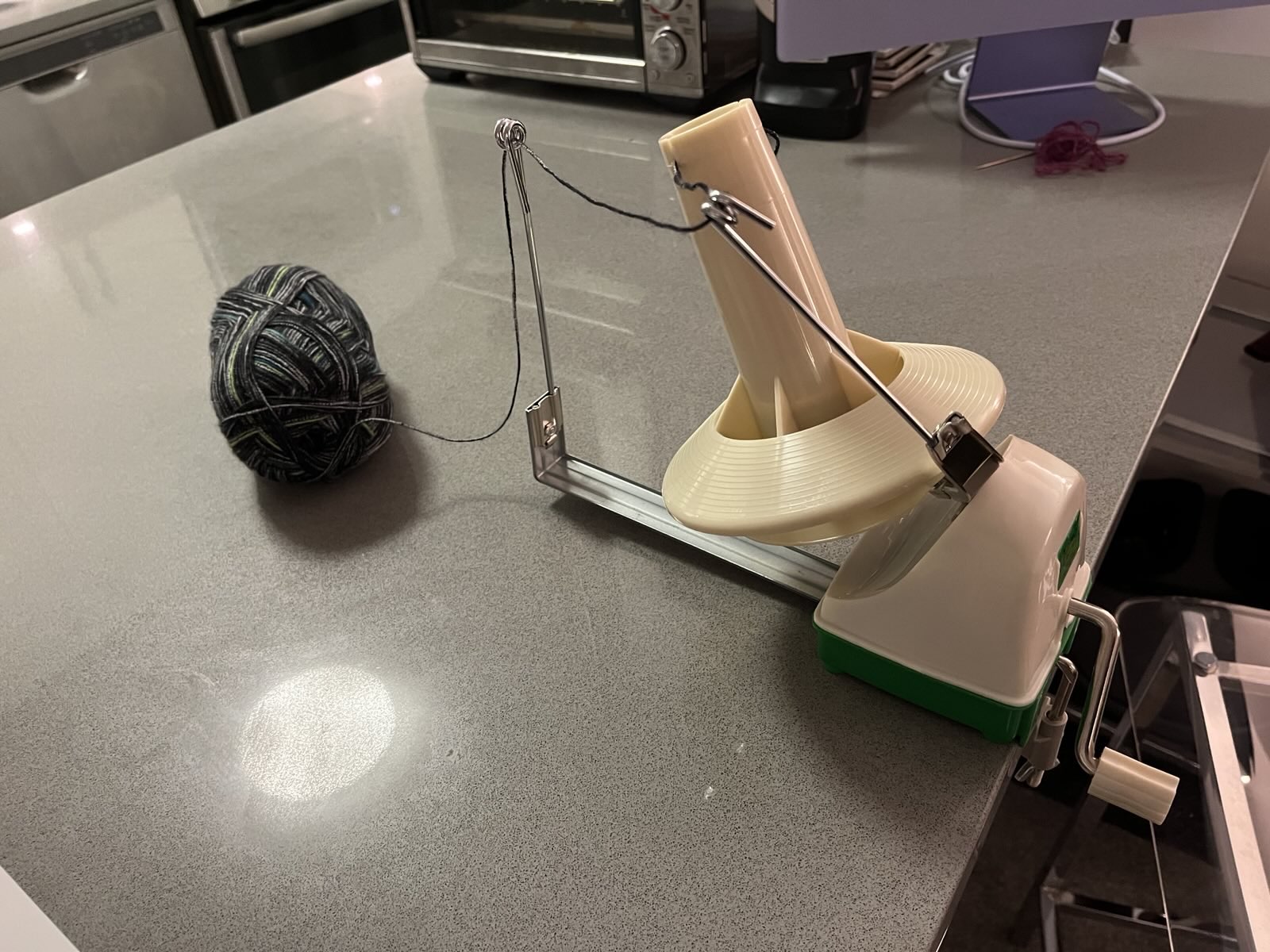
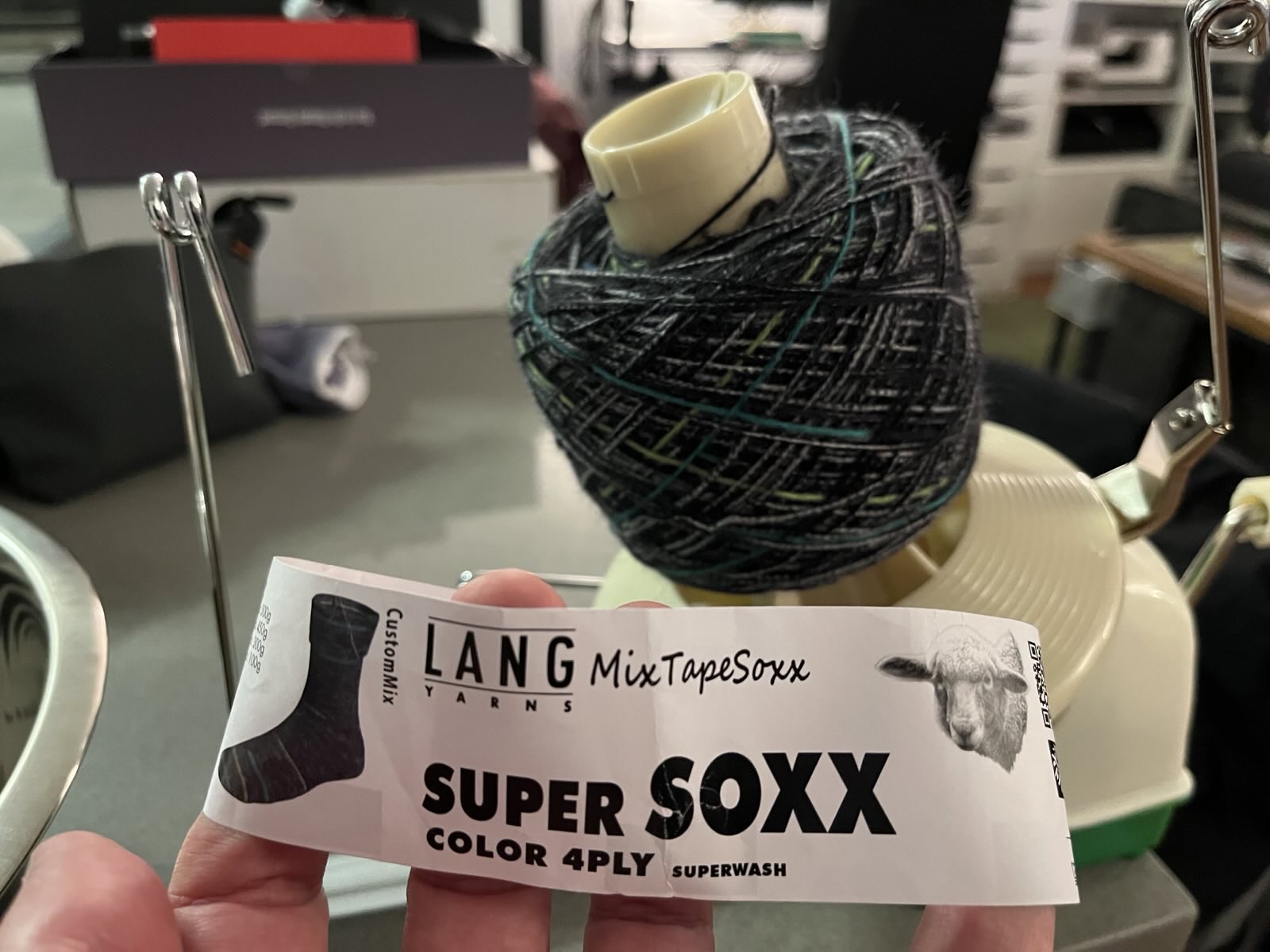
Diana calls for superwash sock yarn, so I picked up a skein from Knitty City while I was out on some errands. I finally got to try out my fancy new yarn winder, which was pretty fun.

Yarn winder attached to countertop, ready to turn this skein into a cake.
Caked yarn on the winder posed with the label for the yarn. Lang Yarns MixTapeSoxx Super Soxx color 4-ply superwash.
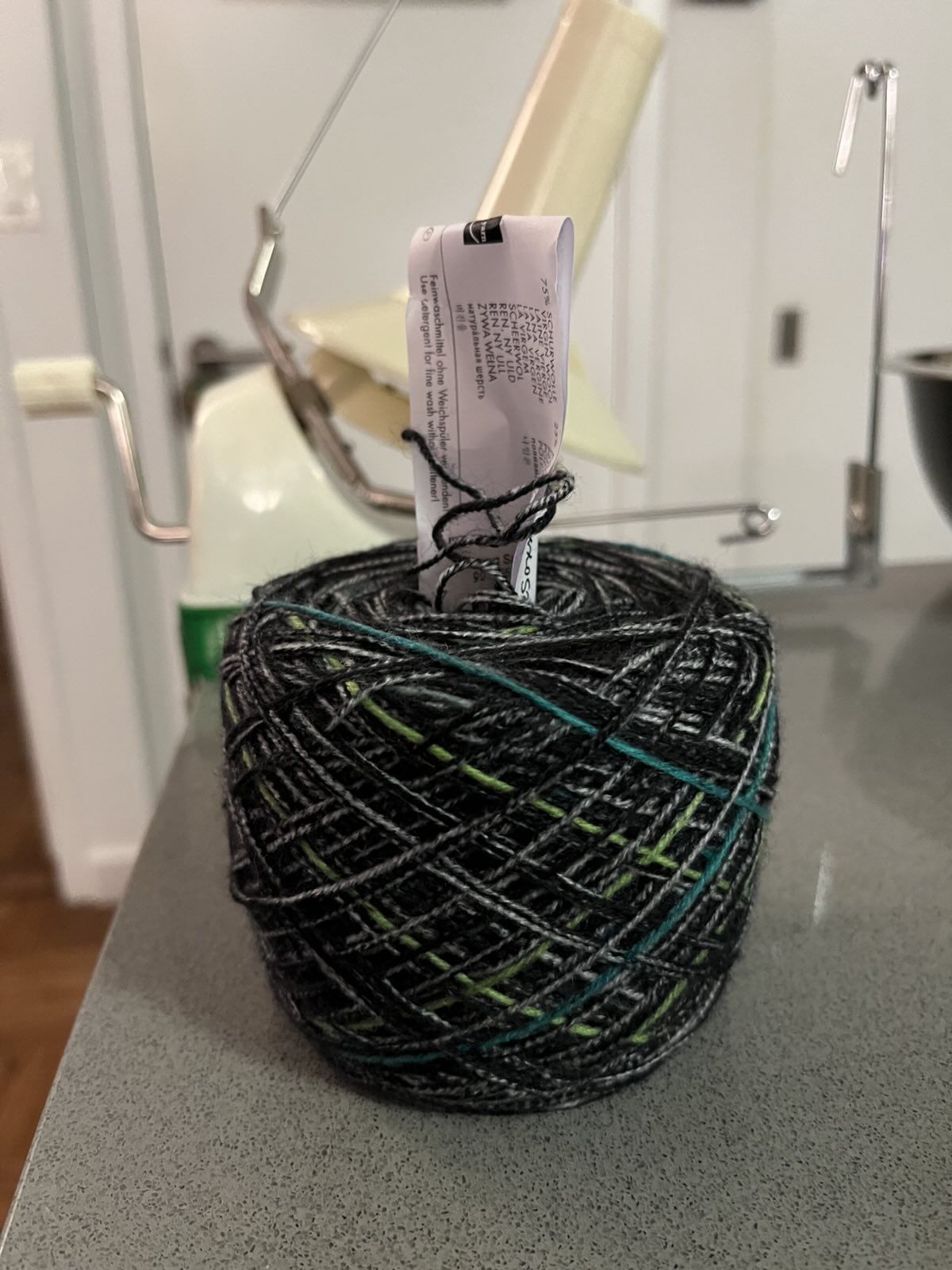
The cake extracted from the winder, with the label stuffed into the center like I saw @KnitFactoryImpl do it.

Each mitt is knit in two parts:

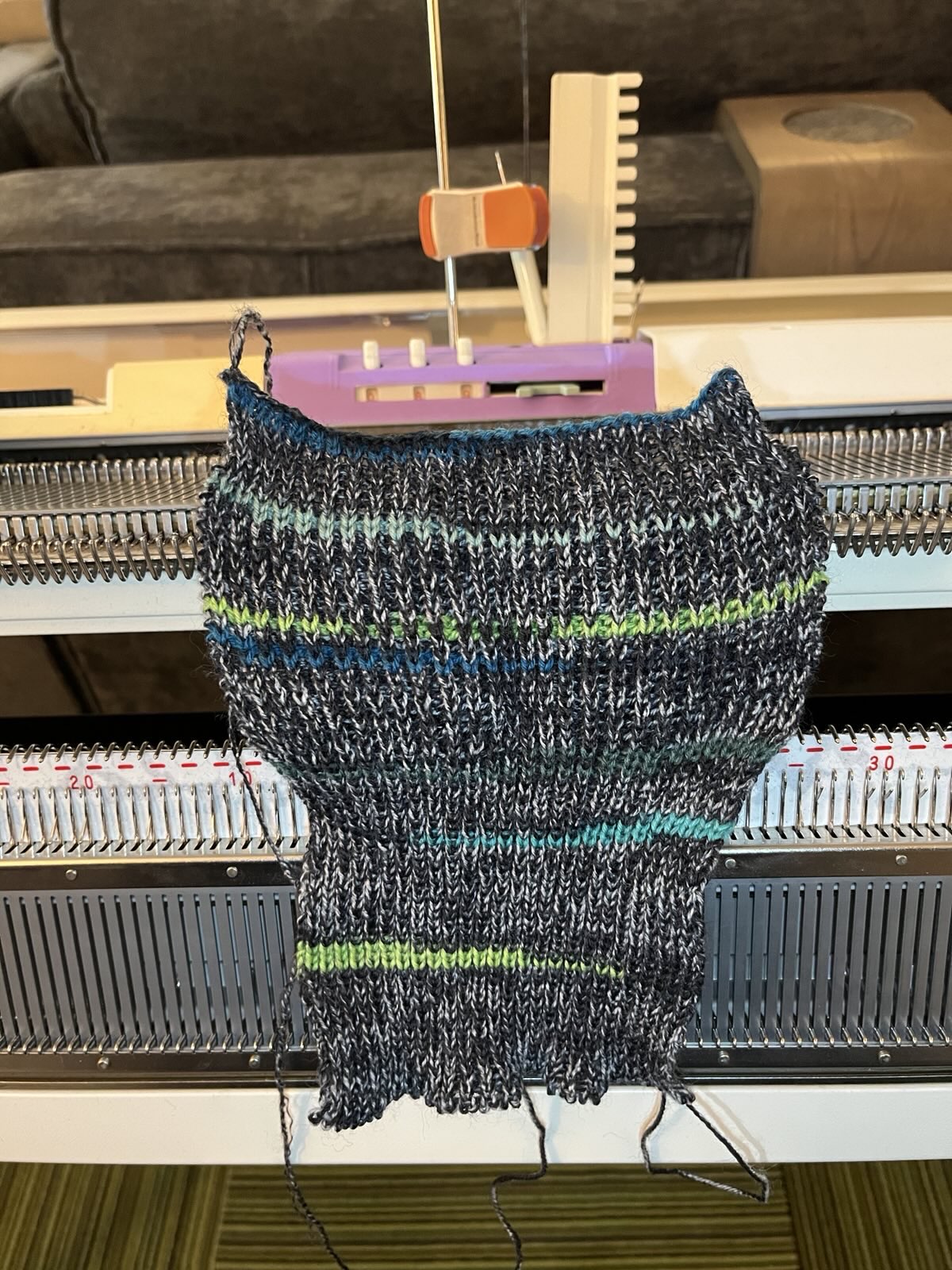
  • The main body is knit from the wrist-up. 51 stitches set up for 1x1 rib (I used 53). Do 40 rows of the 1x1 rib. Then switch to English rib by setting the ribber carriage to tuck to the left and do another 40 rows. Back to 1x1 rib for 8 rows for the top of the mitt. Finally, transfer all stitches to the main bed, knit one row at the loosest tension, and do a loose loop-through-loop bind-off.
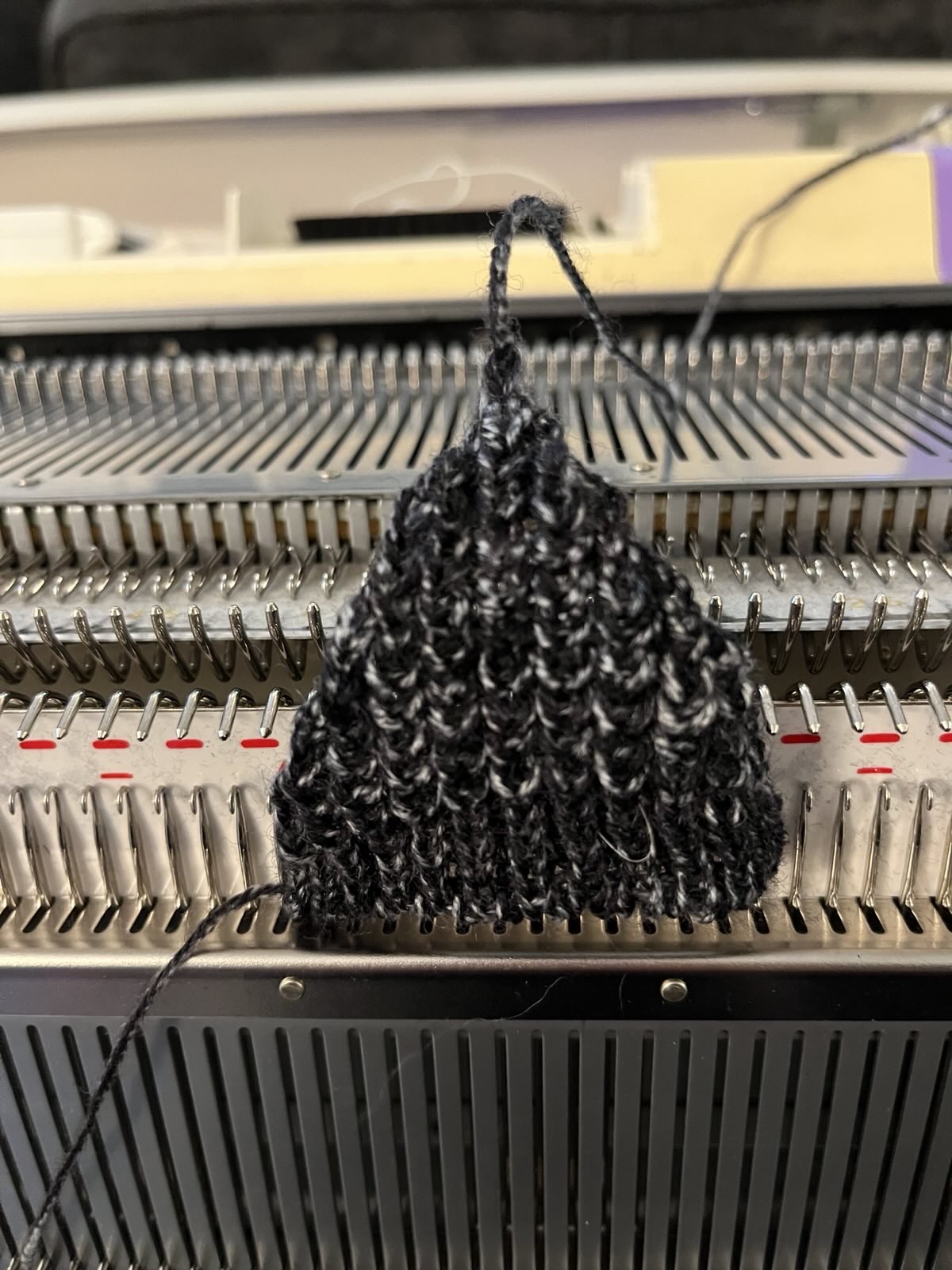
  • The thumb portion is knit as a triangle, starting from the tip of the thumb. 25 stitches in 1x1 rib for 4 rows. Switch to English rib and decrease by 1 stitch on each bed on each side (so, 4 stitches total). Repeat until you're down to 1 stitch, knit twice on that one needle, and you're done.
Body of the mitt, fresh off the machine.
The little thumb cover!
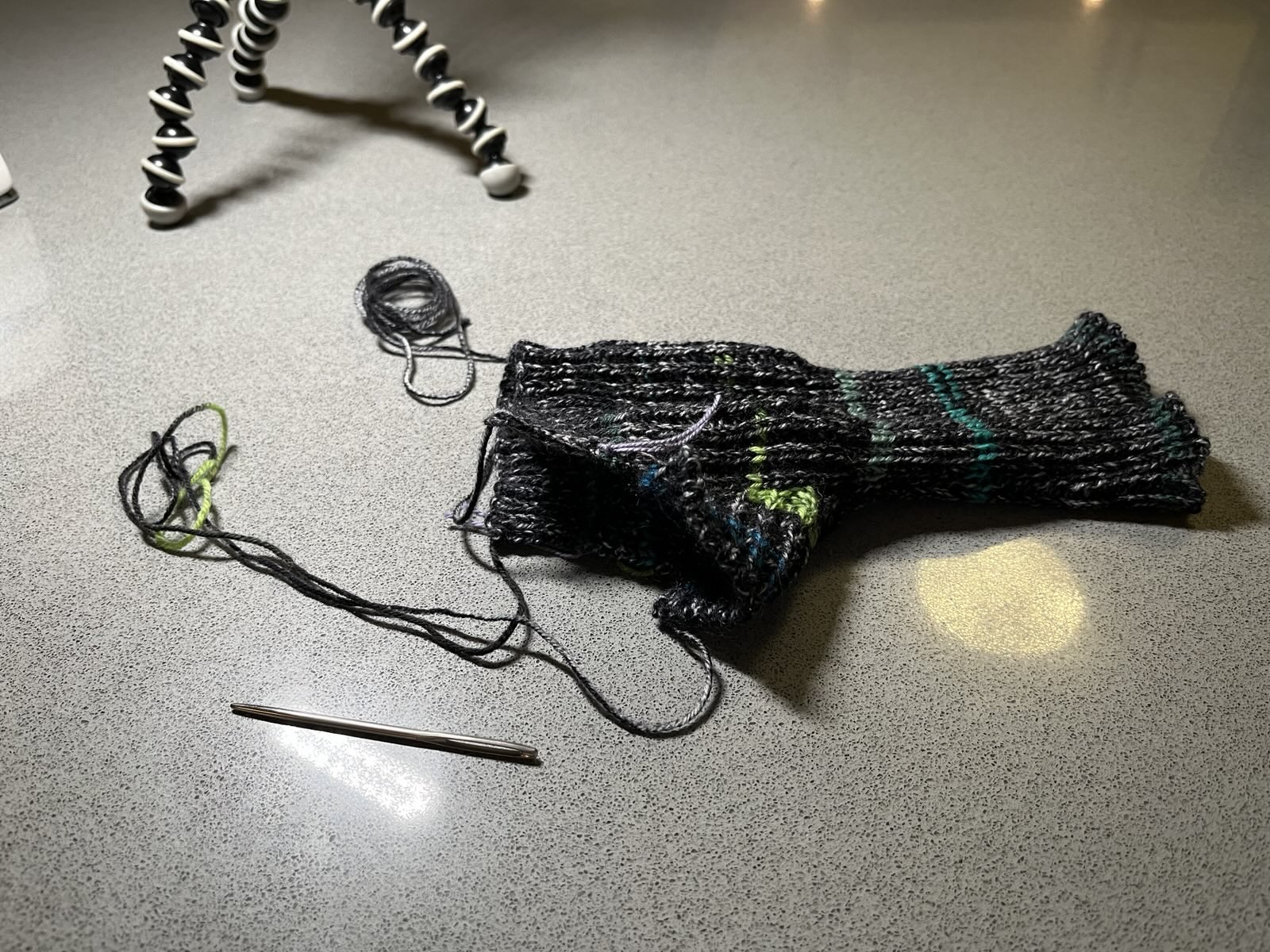
I'm still pretty new to sewing-up knits, so I ended up doing the first one in stops-and-starts. It begins by attaching the thumb piece to one side of the body by lining up the tiny triangle end of the thumb to the first row of English rib on the body.

I did my best approximation of a mattress stitch here, making the mistake of trying to also "match up" the English rib sections of both pieces, even though the body had a lot more stitches of rib to work with.

In-progress sewing-up photo of the mitt. The thumb has been attached to one side. The thumb has been incorrectly sewn to the mitt all the way to the top, leaving no stitches to close around the thumb itself.

Thankfully it was easy to unravel my mistake. I made things a bit easier for myself on the second one. It paid to go slow and simply count stitches, stopping when I ran out of English rib stitches to sew from the thumb.

Second mitt ready to sew up. The transitions between 1x1 rib and English rib are marked with purple stitch markers.
Second mitt in progress of being sewn up. The mitt has been sewn up the wrist side, joining the other side of the thumb. The last gap to close is from the top of the palm area to the top of the thumb.

With the thumb attached to one side, you then sew up the wrist, joining the other side to the thumb. Stitch markers helped me identify the 1x1 to English rib transition points.

To close it up, I ended up sewing from two directions - from the top of the palm towards the thumb crease, and from the top of the thumb towards the same. I ended up with all the long ends coming together in the thumb crease, which made a nice place to tie a couple of knots to secure them and snip the ends.

These were fun and fast to make, machine-wise. I have a lot of work to do to build my sewing-up skills and speed.

I was surprised to find that they even mostly fit my larger-than-Diana's hands! The ribbing is super stretchy. The only place they bind is at the top of the palm, where I probably did a too-tight bind-off.

Sunlit mitt on my right hand.

👍

I've worn these around the house for a couple of days and could happily continue to do so. However, I want to try a slightly larger size, probably another 4 stitches wide and with another 8 rows of English rib for the body. I'm hoping that this pair fits producer Amy so they can get some good use!

Thu Nov 27

Today was a good day, I think, for making a little bow.

Thanks to Knitology 1x1 for the step-by-step machine knit bow video!

A small bow knit from fuzzy green yarn.
Mon Nov 24

Machine knitting: neckli(n)e / show-and-tell!

This post is part of a series, as I play catch-up on KnitFactoryImpl's knitalong of a set in sleeve crew neck sweater for channel members.

After completing the front panel, only one major on-the-machine task remains for this sweater, and that's the neckline.

This is easy to explain conceptually: connect the front and the back by seaming them together at one shoulder, rehang all the stitches on the knitting machine, knit some rows for the collar, then cast off on waste yarn.

Still, I was dreading this for some reason, so I procrastinated on it all day and then hemmed-and-hawed as I did it.

One shoulder: seamed! The view from the inside.
The seam viewed from the outside.

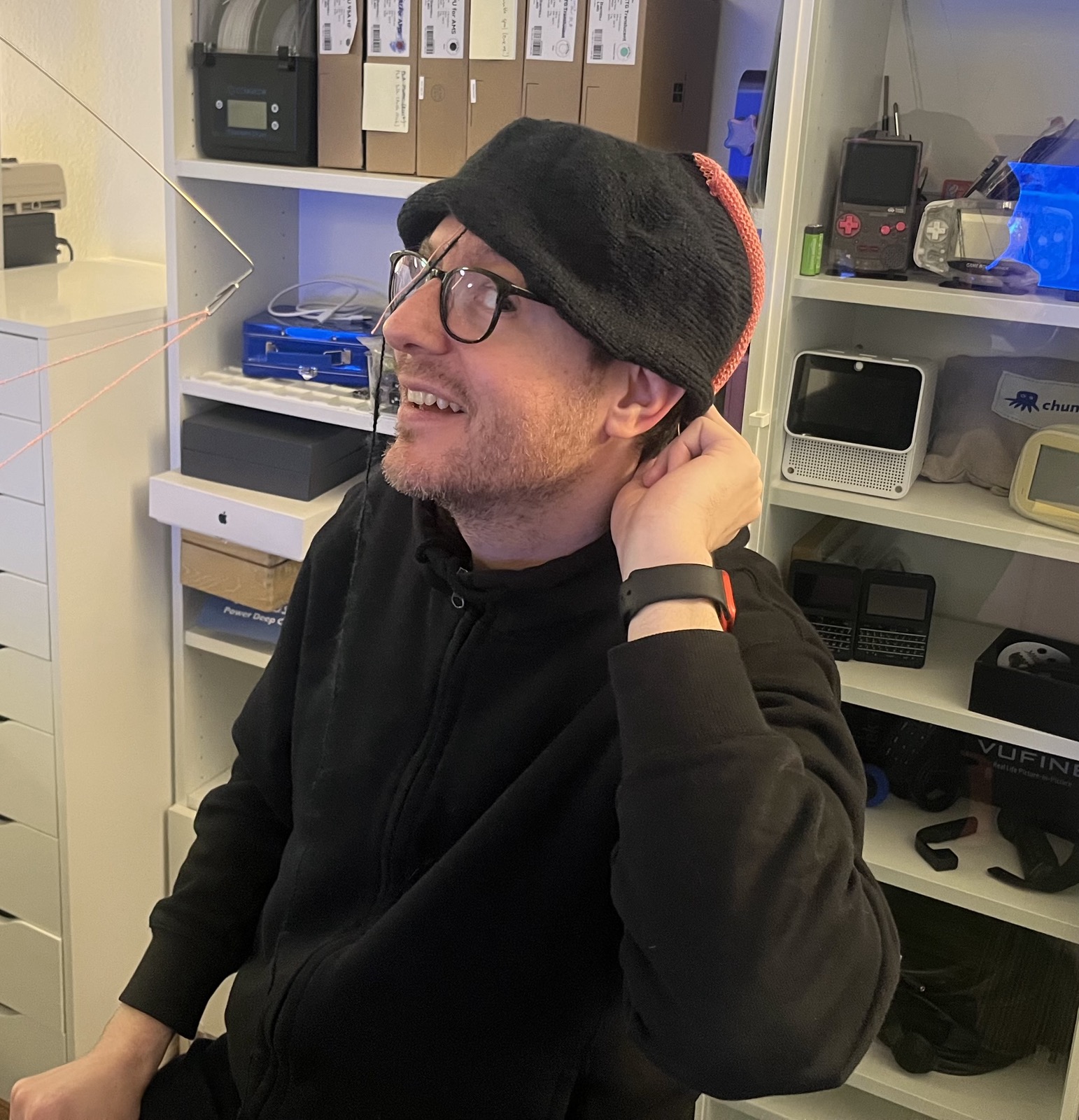
Technically, the last bits of shoulder seams should include some purple stitches, but I found it too mind-bending to think about how to change colors while so many needles were going into hold and being wrapped. It's really just a few stitches so I don't think anyone will notice in the final sweater.

I then took a long break for food, exercise, and a shower, and only actually started hanging the neckline on the machine about 15 minutes before the live show-and-tell. 🫣

Can I knit and participate in a livestream event at the same time? Not really!

I really enjoyed the show-and-tell. It was encouraging to hear KnitFactoryImpl's own challenges and inspiring to see the final (extremely fluffy!) cardigan. I was delighted and honored that she shared my posts from this very website with some kind comments on my knitting setup and progress photos. I loved seeing photos from other participants, too! It was nice to have enough context to understand and appreciate some of the choices made in terms of stitch variety, yarn types, and (of course) colors and patterns!

I ended up waiting until after the livestream to finish hanging the stitches.

Once it was all back on the bed, following KnitFactoryImpl's advice, I:

  • hung a bunch of weights.
  • knit one row of normal knitting (at a slightly looser tension than the main body).
  • transferred half of the stitches to the ribber for 1x1 rib.
  • added more weights.
  • set up the carriages to knit the rib the same as I had done the cuffs and body panel hems.

I even got to use these cool weight hangers on the edges!

These made no sense to me until I saw a photo in the KR-850 manual.

After all the effort to hang the stitches, set the weights, set up the carriage, knit the one row of stockinette, remove the carriage, transfer half the stitches, set more weights, and set up the carriages again, I was feeling pretty nervous about this going awry.

So I knit 12 rows of 1x1 rib very slowly, checking each stitch after every row. This was made more challenging by the fact that my main yarn is pitch black. 😅

To my relief, those 12 rows went great! It was time to cast off onto waste yarn with circular knitting. So, I switched yarns, set the carriages for circular knitting, knit a few rows back and forth-

- and realize something was going very wrong! The tension from the weights just seemed to be not working. A bunch of stitches piled up loosely and then started dropping.

I didn't panic, but I did remove all the weights and start painstakingly removing the tangled knitting from the bed.

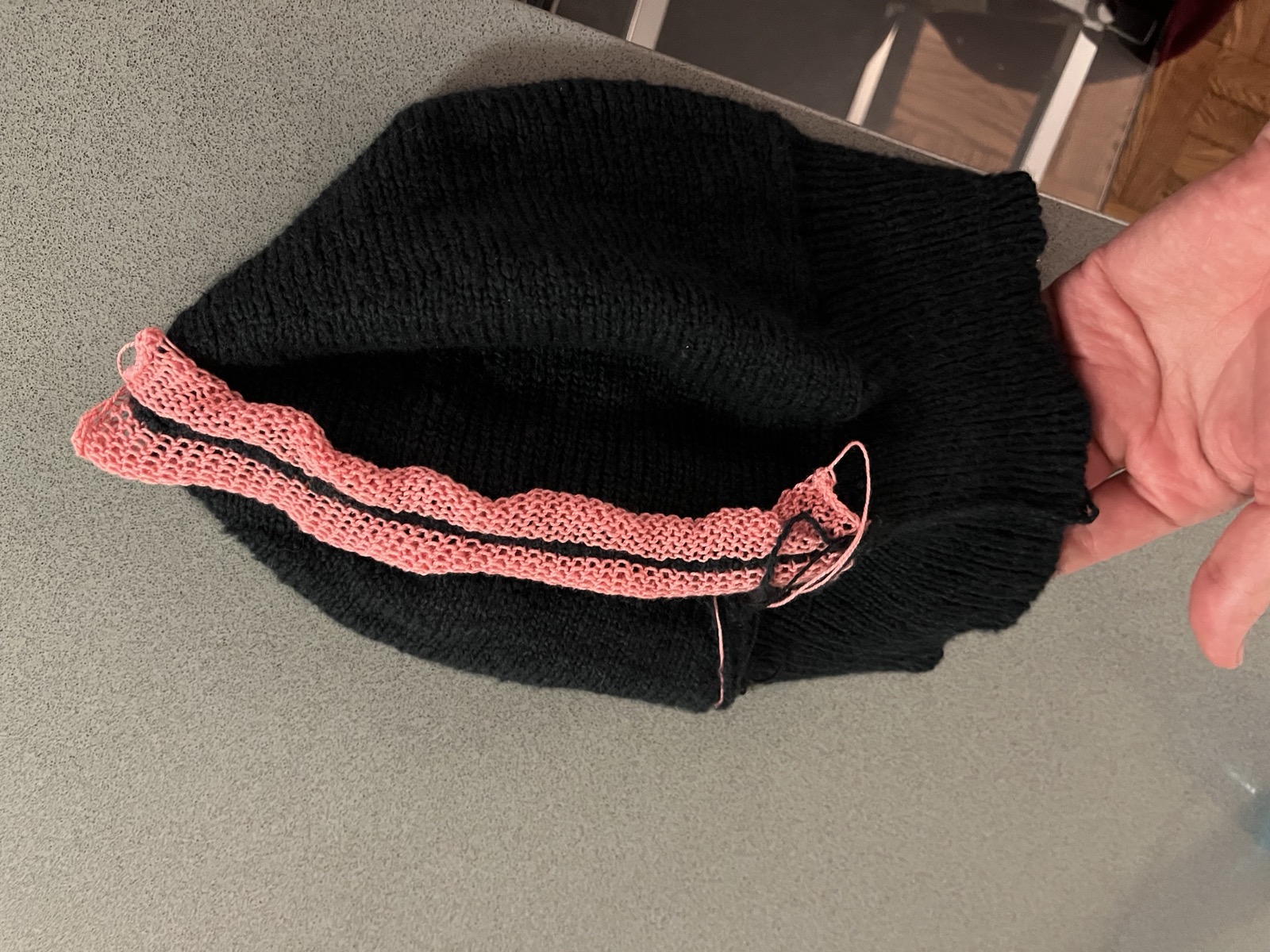
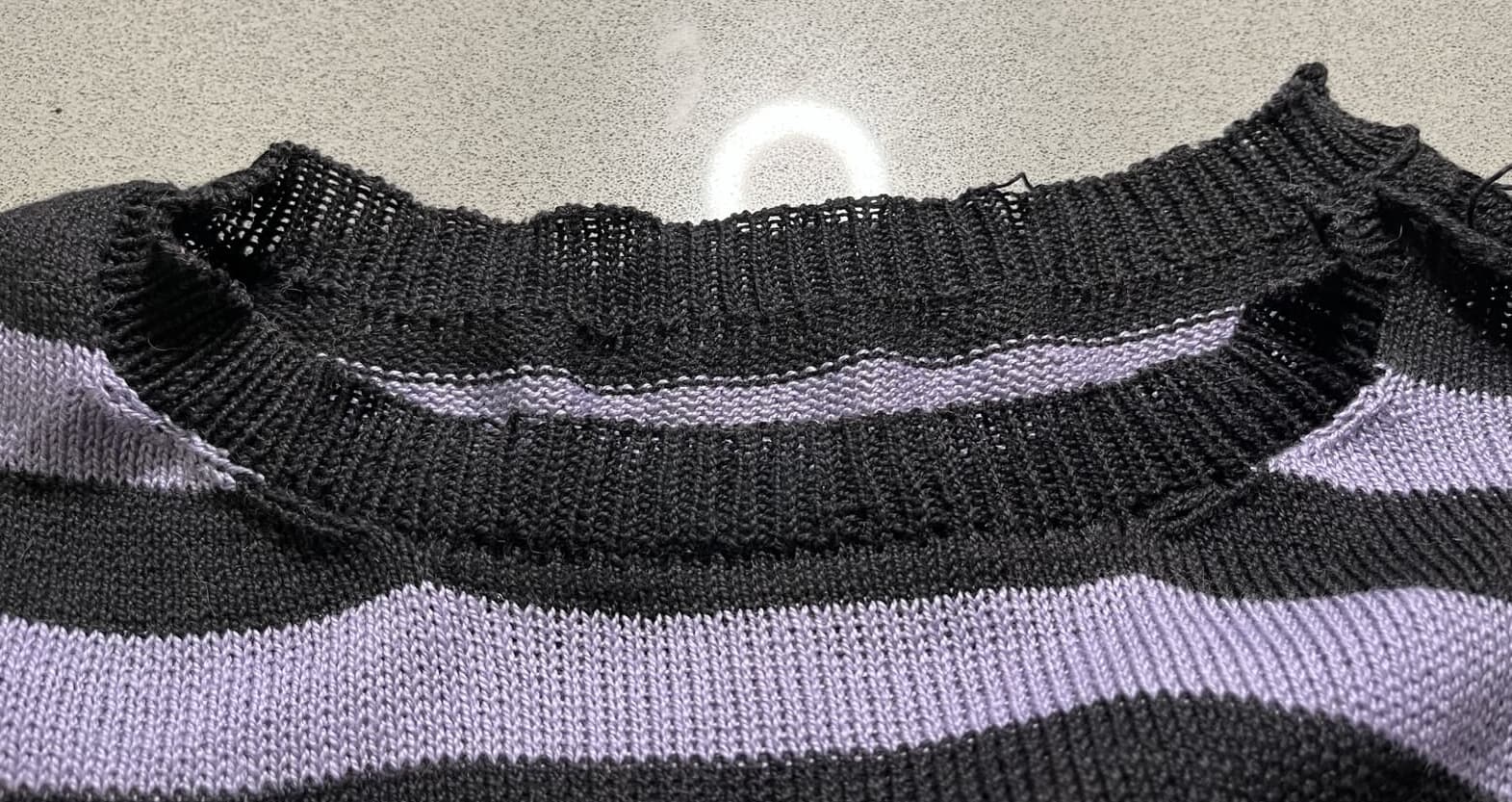
Yikes. Only one or two loops of the pink waste yarn are protecting the live stitches at the end of the collar.

Most of the actual rib came off the machine fine. A few stitches have dropped but, in theory, I can fix those while sewing up to finish the seam. HOWEVER: sewing up seams is definitely one of my weaker skills, so I am not sure I trust myself to do it without making a huge mess of things.

For the sake of my future as a machine knitter, I think I will probably pull all this ribbing off and try again. It will be a time-consuming process, but it's safe to do. Importantly, it will give me a chance to figure out what bits of the knitting machine / stand / cast-on comb / hanging weights are interfering with one another, causing the stitches to bunch up after that dozen-or-so rows.

I could also stand to practice seaming and mending, a good reason to try and "rescue" this delicate collar situation.

Which will I choose? Will I let this project languish now that the knitalong is over? Stay tuned to find out!

Meanwhile, many thanks to KnitFactoryImpl for running this knitalong, for providing a super versatile free pattern generator, making extra videos to detail each piece, and pulling together and sharing photos and more from the community! Also, you know, for the tons of great instructional and inspirational machine knitting content! Go subscribe and support her channel, already!

Sat Nov 22

Machine knitting: front panel / looking forward

This post is part of a series, as I play catch-up on KnitFactoryImpl's knitalong of a set in sleeve crew neck sweater for channel members.

At the dawn of the final day of the knitalong, I was determined to finish the machine-knit portions of the build. That means making the front panel, seaming the front and back along one shoulder, rehanging the neckline, and knitting the collar.

The front panel is constructed about the same as the back panel, but with differences in the neck and shoulder shaping. Compared with my rough go of it on the back panel, the front panel went much easier. I found myself tripping over the combination of working the pattern and switching yarns for the colored stripes. And I'm afraid that no one on Earth knows exactly how the stitch and row counts on the arm hole and neck actually shaping turned out. Future me will, unfortunately, become the one to solve this puzzle.

Great success up to the arm hole bind off!

I played gravity chicken with the cast-on comb and weights and, unfortunately, they were near touching the ground just as the pattern called for the long series of decreases for arm hole shaping. I was able to hang the regular cast-on comb, but it added some complication with moving those stitches. If I had to do it again, I'd make sure to re-hang all the weights 10 or so rows before that.

Yarn (and my stress levels) under tension as I work the left neck and shoulder.

I also regret being precious and/or clever with managing the out-of-work yarn. To keep down the number of ends to work in, I let the out-of-work yarn float from one section to the next. For straight sections, I should be able to hide the floats in a seam. For areas with decreases and bind-offs, I should have just snipped yarn and worked in the ends as I went. I think I'll be cutting and adding extra yarn to several floats that ended up being pulled shorter than the stitches they are meant to hide among. 😩

Looks like a body panel of a sweater!
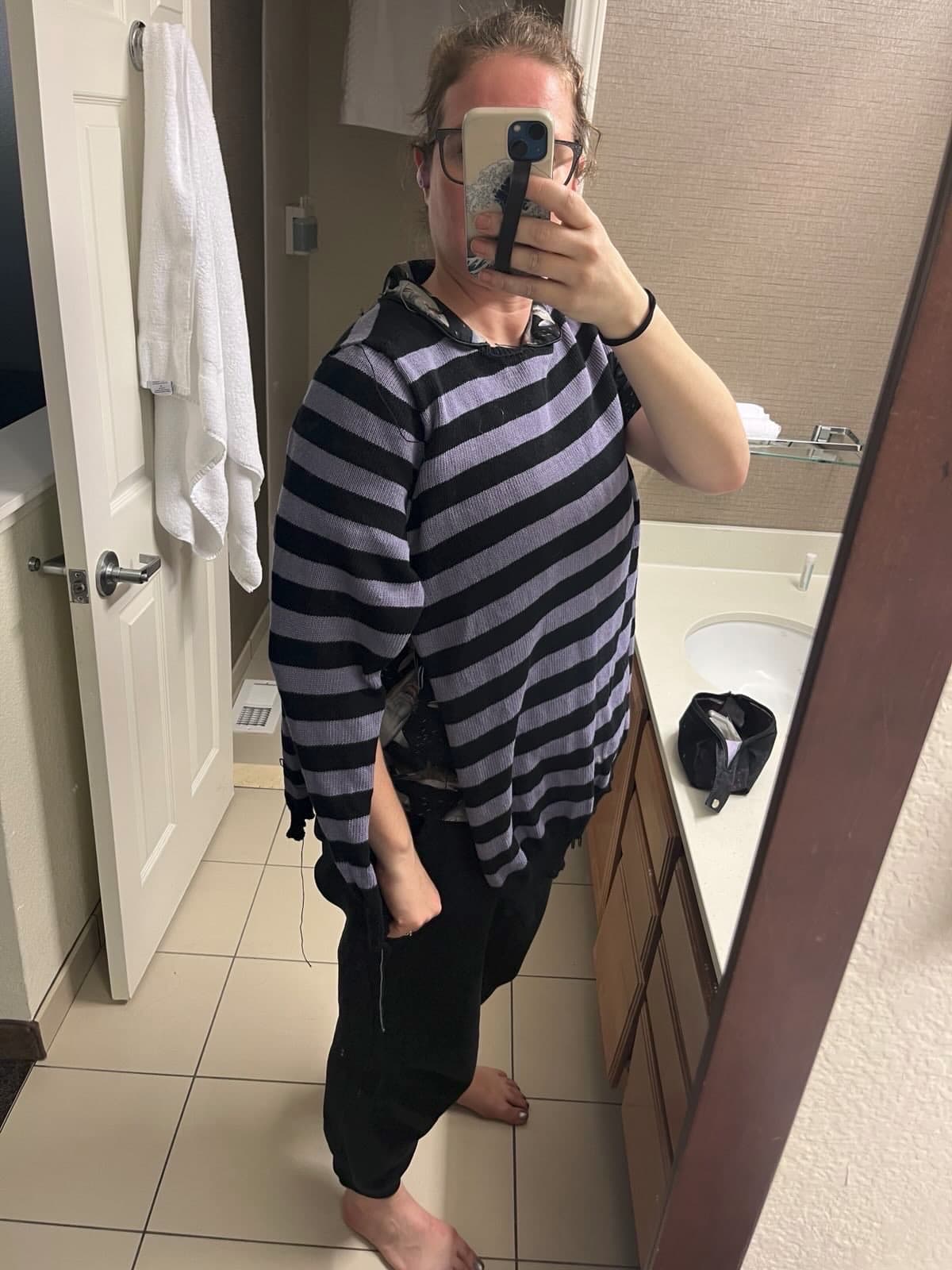
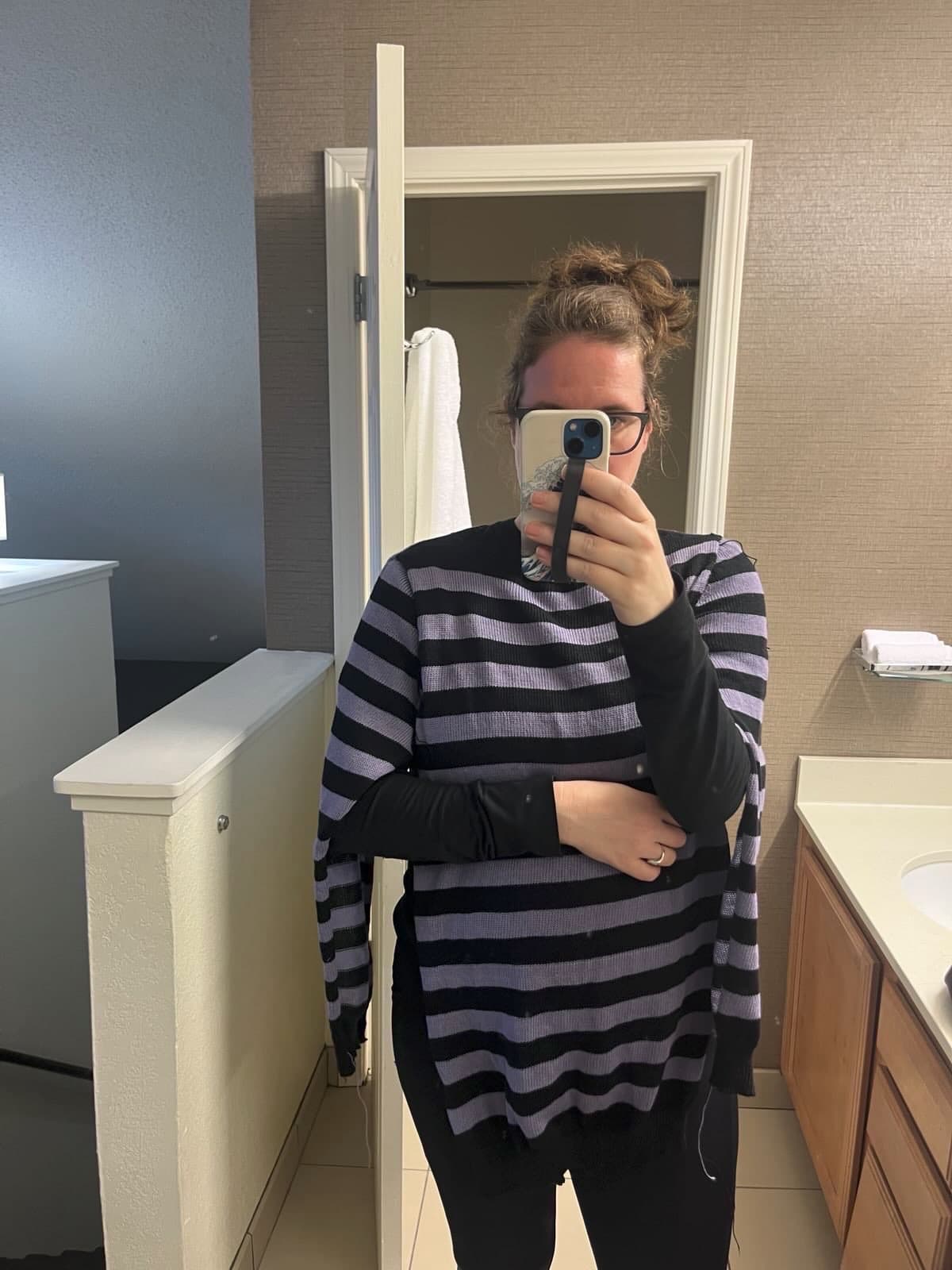
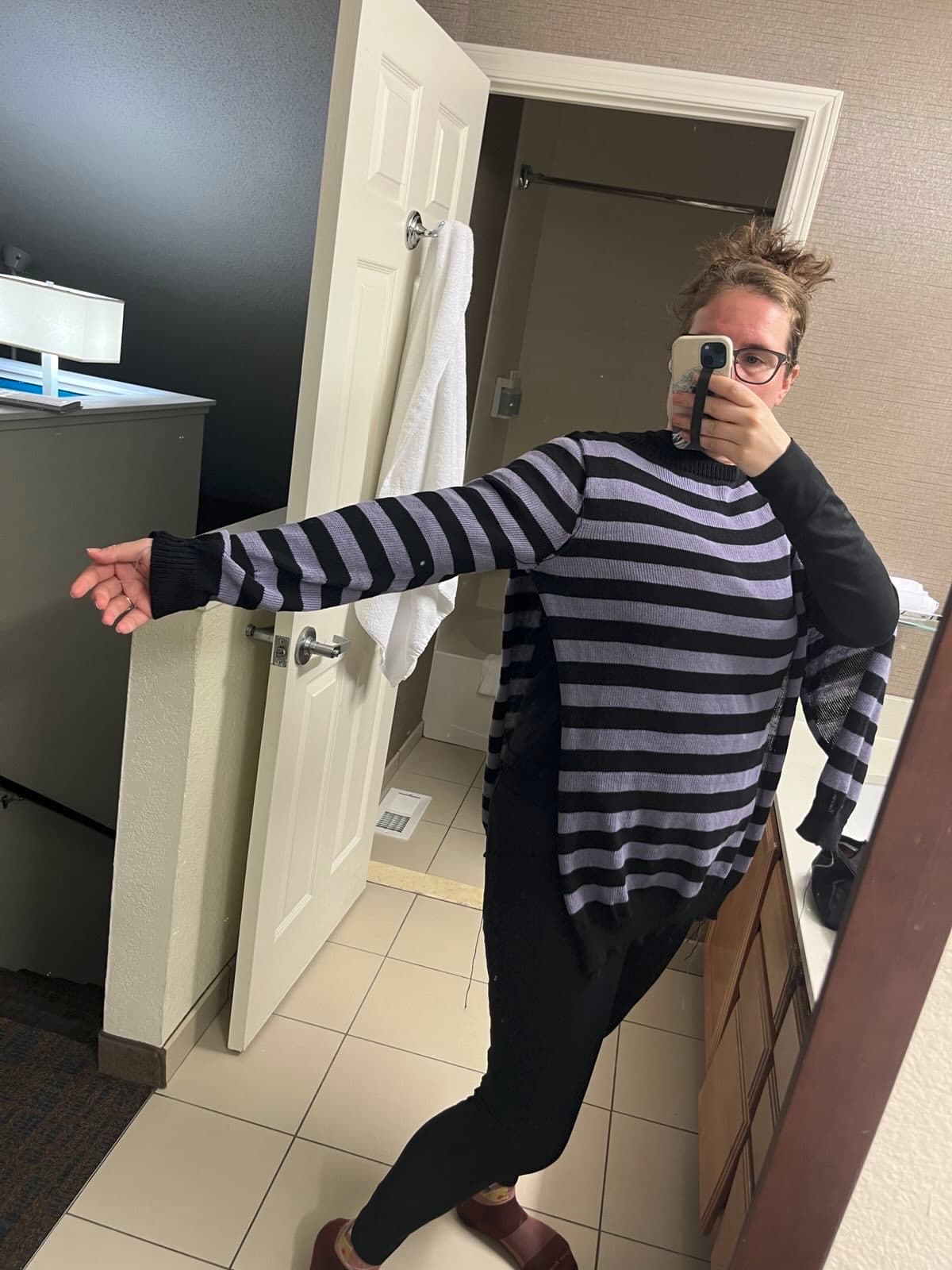
Hanging it on my body has me worried about the arm hole depth, but we march onward!

With breaks for food and stretching, it took me about 4 hours to get through this body panel. With my other obligations for the day, I don't think I'll be able to finish the neckline tonight. But, hey, there's always tomorrow!

I'm not super confident in how this is gonna turn out, but I'm proud that I've pushed through so far! Plus I got to try draping all the major pieces on!

👍🏻

Fri Nov 21

Machine knitting: back panel / backlog

This post is part of a series, as I play catch-up on KnitFactoryImpl's knitalong of a set in sleeve crew neck sweater for channel members.

In the first installment of this series, I made some sleeves, putting me well on time for the knitalong. Since then, however, I spent two weeks in Berlin, a few days sick, and some days catching up on work. All that adds up to: the knitalong is already practically over! 😱

However, I can't let that get me down. It's not homework, there's no grade. I just want to practice some skills, learn some new ones, and make producer Amy a nice sweater. So, let's cast on and get back to it.

The second video in the knitalong series is on body panels. I started with the back. A process that was meant to look something like:

  • Cast on 1x1 rib and knit the bottom hem.
  • Transfer stitches to the main bed and knit the body (a long rectangle of plain knitting).
  • Shape the arm holes by binding off some stitches, then decreasing for a bunch of rows.
  • Shape the shoulder and neck by working one side at a time.

Because I'm working this sweater with a pattern of stripes, I peppered the printed instructions with the row count and color for each color change. This would become important when switching "sections" of pattern that restart the row counter to 000, and doubly important for the shoulder shaping, which has to be worked twice.

Tough to see in black yarn, but here's a ribbed hem for a body panel!

This was my first time casting on a 1x1 rib across almost the entire bed. I found it challenging to get the ribber's full-bed cast-on comb. In my first failed attempt the comb was one needle too far to the right and got caught on a piece of the machine. For the second attempt, one of the weights got stuck on a piece of my knitting machine stand, causing stitches on that side to bunch up and drop. Seen above: I finally got it right!

After transferring the stitches from the ribber to the main bed, it should have been smooth sailing for the main body. Unfortunately, working the striped pattern proved challenging with so many stitches on the bed. The area for "parking" the non-active yarn ends up under the carriage, making it easy to tangle and create long loops. And, oh no-

Dropped about half the stitches off the bed during a color change. 😭

Just over halfway through the main body, after switching colors and, I SWEAR, checking that the new yarn was properly in the carriage feeder, I dropped off a ton of stitches.

Thankfully, this was recoverable, if tedious.

  • Remove all weights from the work.
  • Carefully remove the work from the machine.
  • Go back to the last row of the previous color stripe and re-hang the live stitches. At 185 stitches this was quite tedious!
  • Reset the row counter to match.
  • Hang a cast-on comb and some weights.
  • Resume knitting, redoing the stripe that was dropped. It will be removed after taking the piece off the machine.
The new, somewhat ridiculous, weight configuration. Photo taken after several successful stripes.
The more recent rows of stripes. The ribber sure gets in the way of photos!

That was, thankfully, the only major disaster.

When I made it to shoulder bind-off, I pulled up the knitalong video to start double-checking steps. The bind-off went fine. The reductions for the shoulder holes was made more complicated by needing to switch colors in the middle, but went pretty okay!

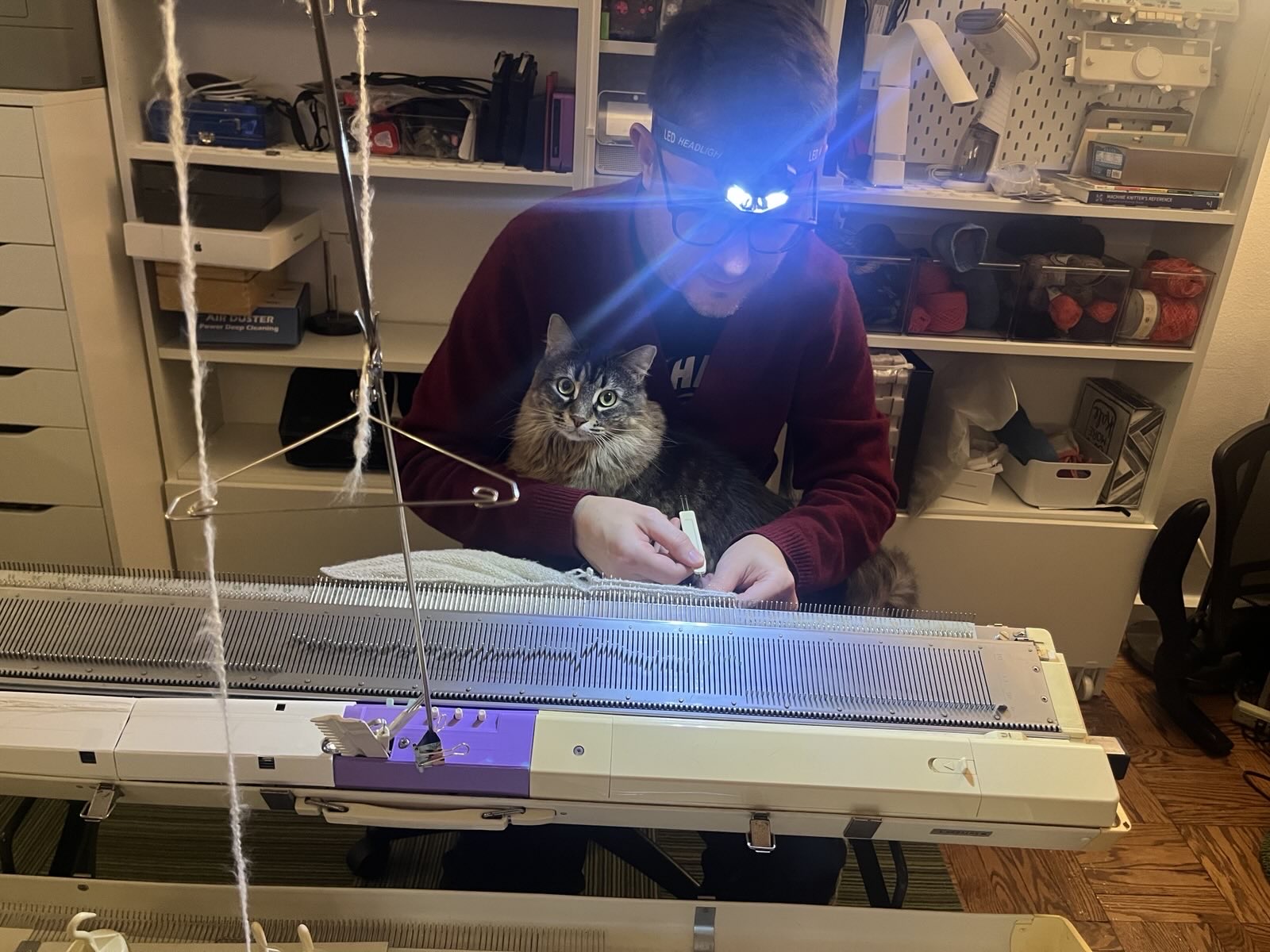
Ready for neck and shoulders. Lolly cat is staring because I'm wearing a neck light and moving lights cannot be trusted.

At this point, it was time to work the shoulders one at a time. I referred to the video multiple times. I goofed up and dropped some stitches that I was thankfully able to recover. I took it slow and sweat the details. I nodded along at the concept of short rowing on two sides as I watched the video a 5th and 6th time. I ver-ry care-ful-ly bound off stitches. I counted and recounted and still somehow ended up off-by-one stitch somewhere along the way.

But I finished! And I think it will be okay!

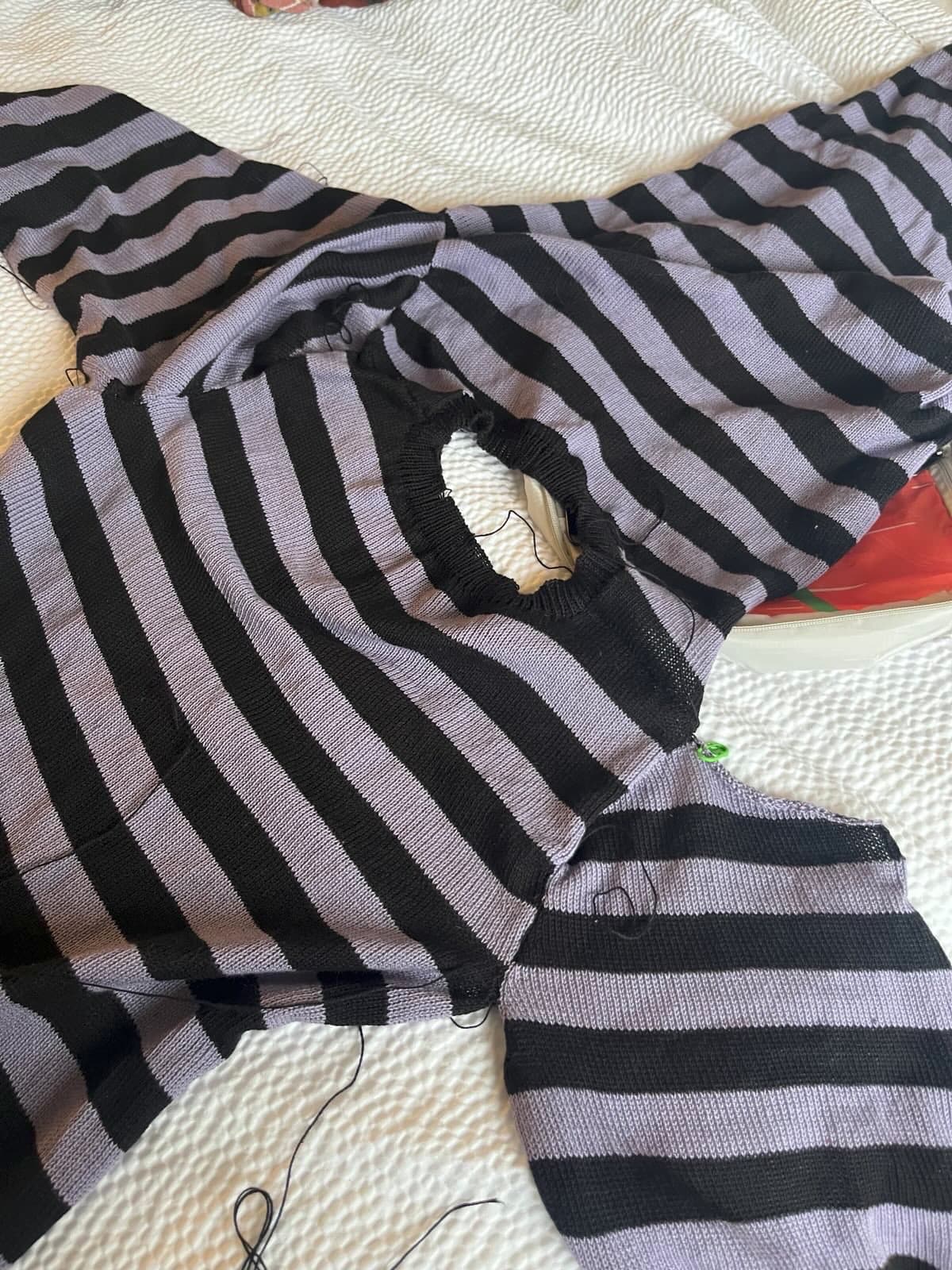
Test fitting by laying it on my back. Sure! Seems like a thing!
I'm expecting this to relax and shrink up  after washing!

I worked on this piece on and off all day, in between work and meetings and phone calls. I definitely putting in at least a few solid hours of work, mostly in recovering from mistakes. I wrapped around 10pm to write this post!

I'll be back at it tomorrow! My hope is to at least finish the front panel and the neckline and get a post online in time for the knitalong's Sunday show and tell. I'll still need to seam the final shoulder, sleeves, and sides, but I'll have finished the machine knitting part of it, and that should feel pretty good.

OK, see you tomorrow!

Tue Nov 11

Today was a good day, I think, for finishing a little guy that I’ve been carrying around incomplete for a couple of weeks.

Round little guy with a fuzzy green body, white hair, and silver safety eyes.
Mon Nov 10
📗 Want to read Texture and 3D Effects by Amber Hards ISBN: 9780719842382
Sun Nov 9

I’m traveling but that doesn’t mean I’m not machine knitting!

I am so grateful to Cristina Talpa for her make-a-scarf workshop. Amy found it via the Makery and we thought it seemed too good to pass up.

And it was! While the workshop is geared for total beginners to machine knitting, Cristina smoothly adjusted to work around things I already knew. She taught me some great new techniques and helped me improve some less-than-optimal techniques I came to the workshop with.

Plus, this scarf! I love it! Amy enjoyed posing me on an outing in Berlin today to snap a few photos.

I’m so grateful for the opportunity to meet an expert (and experimental!) machine knitter, work on a garment together, and chat about the state of the craft.

Thanks so much, Cristina!

Me bundled in a scarf with strips in gray and dark and neon green, standing on a trail in autumnal woods. Me smiling, bundled in my scarf, standing in front of a fallen tree with thick reaching branches. Me bundled in a scarf of dark green, neon green, and gray sections, standing in front of a graffiti-covered wall.